Most brand owners can describe the drink they want but not how it gets made — and that gap is where budgets blow out and timelines slip. Understanding the beverage manufacturing process is not about becoming an engineer; it is about knowing which steps decide cost, safety and shelf life so you can ask the right questions. With the non-alcoholic market projected to reach about $2.55 trillion by 2030, the brands that understand production move faster than those that don't.
Why we wrote this: We walk new clients through this process constantly, and the same two steps — pasteurization and filling — cause the most confusion and the most expensive mistakes. This guide demystifies the full flow in plain language, so you arrive at your first factory conversation already knowing where the real decisions are.
Key Takeaways
- Beverage manufacturing is a six-stage flow: formulation, mixing, pasteurization, optional carbonation, filling, and packaging.
- Pasteurization and filling are the critical control points — they decide food safety and shelf life.
- For juice, the safety bar is specific: regulators require a validated 5-log pathogen reduction.
The Six Stages, Explained
1. Formulation and 2. Mixing
Everything starts with formulation — turning a concept into a scalable recipe that delivers the target taste, functionality and shelf life. Once ingredients are sourced and quality-checked, mixing and blending combine them into a uniform base. This is more technical than it sounds: ingredient ratios and blend times determine consistency, mouthfeel and stability across every batch.
3. Pasteurization and 4. Carbonation
Pasteurization is a heat treatment that destroys pathogens and extends shelf life. For juice specifically, the bar is legally defined: the U.S. FDA requires juice processors to operate a HACCP system and achieve a validated 5-log pathogen reduction, and notes pasteurization also lengthens the shelf life of refrigerated juices. As Clemson University explains, a 5-log reduction equals a 99.999% cut in the most resistant target organism, commonly achieved with high-temperature short-time (HTST) pasteurization. For sparkling formats, carbonation injects CO2 under controlled pressure.
Reading the FDA's HACCP requirement next to the Clemson 5-log explanation makes the priority obvious: pasteurization is not a generic "heat the liquid" step — it is a validated, documented safety control that your specific product and equipment must prove. For a brand, that means the question to ask a factory is not "do you pasteurize?" but "can you show validation that your process hits 5-log for my formula?" That single question separates serious manufacturers from the rest.
Where Brands Should Focus: Filling
Filling is the step that most affects flavor and safety, and there are three main methods. The FDA notes that milk-style pasteurization of about 161°F for 15 seconds will, in most cases, achieve the required 5-log reduction for juice — illustrating how tightly temperature and time are specified. Hot filling pasteurizes and fills in one pass; cold or aseptic filling fills cooled product in a sterile environment to protect delicate flavors; and retort processing double-pasteurizes canned products. Each method suits different containers and recipes.
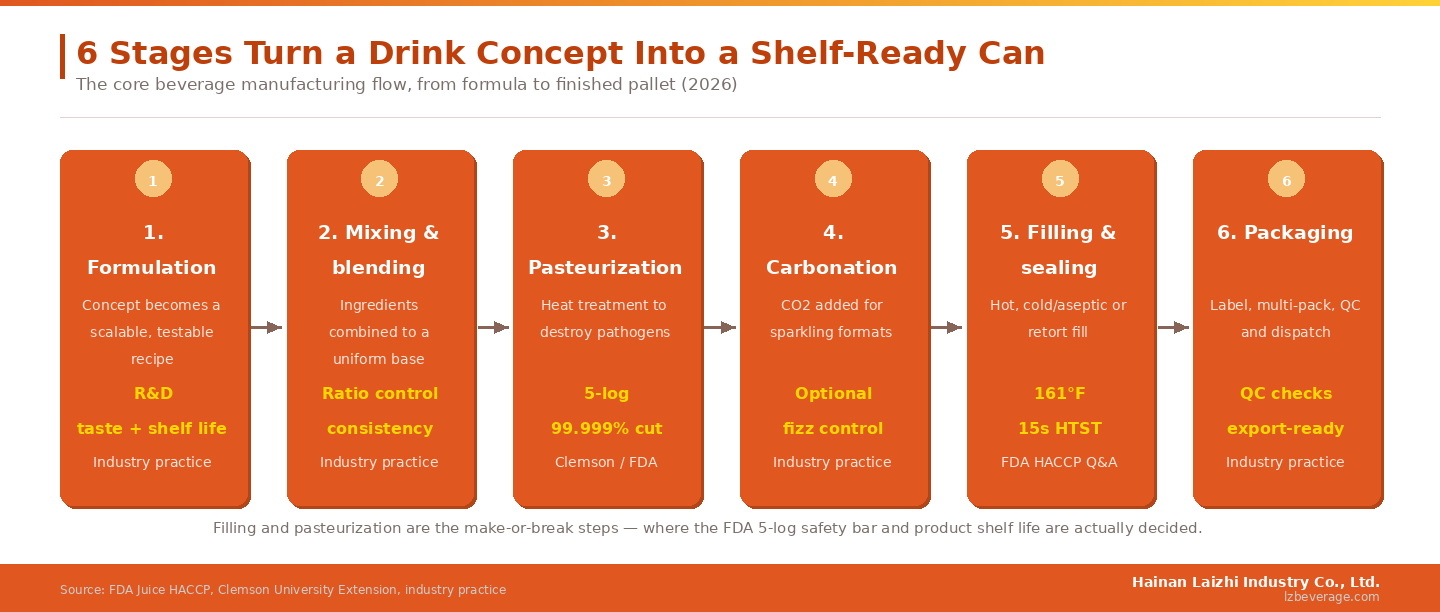
Packaging closes the loop: labeling, multi-packing, quality-control checks and dispatch. By this stage the product's safety and taste are already locked in — packaging protects and presents them.
What This Means for Your Product
Matching process to product
The right process depends on what you are making. A carbonated energy drink needs precise CO2 control; a juice needs validated pasteurization; an aseptic RTD needs a sterile fill. A one-stop beverage manufacturing partner running multiple lines can match the method to your formula rather than forcing your idea into a single available process.
Why this lowers your risk
Functional and RTD demand keeps rising — RTD functional formats are leading the move toward a near-$250 billion functional market by 2030 — so getting the process right the first time matters commercially. You can review the range of product categories to see which process applies to your concept.
Next-step checklist
- This week: map your product to the six stages above and flag your critical step.
- This week: decide your container — can, PET, glass, or aseptic carton.
- This month: ask candidate factories to show 5-log pasteurization validation.
- This month: request a sample run to confirm taste survives the chosen fill method.
FAQ
What are the main steps in beverage manufacturing?
Formulation, mixing and blending, pasteurization, optional carbonation, filling and sealing, and packaging. The exact sequence varies by product type.
Why is pasteurization important?
It destroys pathogens and extends shelf life. For juice, regulators require a validated 5-log (99.999%) reduction of the target organism, which makes it a critical control point rather than an optional step.
What is the difference between hot fill and aseptic fill?
Hot filling pasteurizes and fills in one heated pass, while aseptic (cold) filling fills cooled, already-pasteurized product in a sterile environment to better preserve delicate flavors. A flexible OEM partner can advise which suits your product.


