Prebiotic soda is not simply traditional soda with fiber added. The hard part is proving that the chosen ingredient system, acid-and-heat process, package, and market-facing language can all survive the same commercial brief. That is why a useful prebiotic soda vs regular soda comparison begins with a matched configuration, not a nutrition halo or a single bench sample.
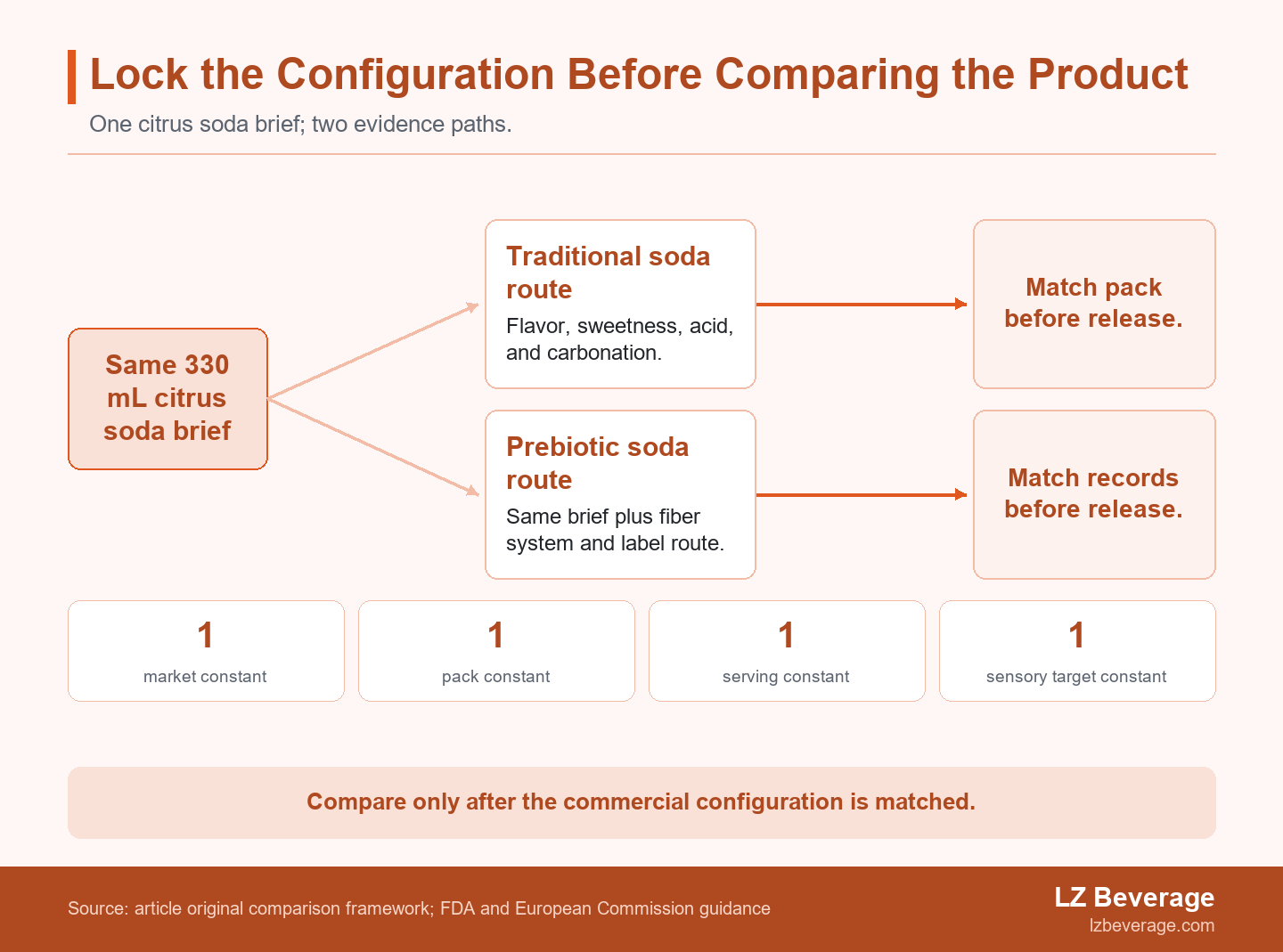
Compare the Same Configuration Before You Compare the Category
A useful prebiotic-versus-traditional soda comparison holds market, pack, serving, and sensory target constant before comparing the remaining formula and positioning work. Holding those four variables still does not approve a formula; it prevents a change in can size, target country, serving basis, or sweetness target from being mistaken for a difference caused by the functional ingredient.
- Traditional soda: the brief usually centers on flavor, sweetness, acid, carbonation, process, and pack.
- Prebiotic soda: those decisions remain, but the selected fiber system and its intended label and claim route become part of the same SKU brief.
- Buyer rule: compare two launch-ready configurations, not two ingredient lists.
| Comparison point |
Traditional soda route |
Prebiotic soda route |
What the buyer must lock |
| Formula brief |
Flavor, sweetness, acid, and carbon dioxide target |
The same sensory brief plus a defined fiber system |
Ingredient identity and serving basis |
| Process proof |
Confirm the beverage process for the selected recipe |
Confirm the process and fiber behavior together |
Proposed heat, acid, and production conditions |
| Package proof |
Match the pack to the finished beverage |
Match the same pack to the final functional configuration |
Pack format and final formula |
| Positioning route |
Refreshment and flavor proposition |
Nutrition or functional proposition requires a market review |
Destination market and approved wording |
Based on this comparison, the functional route does not become a different beverage universe. It becomes a product family with an added chain of evidence: the formula record must align with the process, package, and label route before the buyer can tell which extra work is genuinely caused by the prebiotic position.
The Ingredient System Is the First Manufacturing Difference
For applicable U.S. labels, an ingredient described as fiber is not automatically the same as the dietary-fiber amount that may be declared. In this context, dietary fiber means the carbohydrate amount that meets the relevant FDA label definition, rather than any ingredient a product team calls fiber. The formula brief should therefore name the ingredient, its proposed amount per serving, and the intended label treatment before the pilot is treated as a final commercial comparison.
That distinction changes the first supplier conversation. A traditional soda brief can start with a sensory target and a sugar system. A prebiotic brief also needs the functional ingredient to be specific enough for procurement, formulation, and label review to refer to the same material. “Add a prebiotic” is a concept; a named ingredient system with a serving basis is a development input.
Manufacturing Adds an Evidence Layer, Not a Separate Beverage Universe
Both routes remain carbonated beverages, so ordinary safety, sanitation, additive, contact-substance, and labeling responsibilities still apply. The FDA’s overview of carbonated soft drinks is a useful U.S. baseline: functional positioning adds work, but it does not erase the underlying beverage and packaging responsibilities. For an OEM/ODM discussion, first map the beverage category to your launch brief; the category, pack, and destination market determine which product questions need to be carried into feasibility.
The functional route needs a record of the proposed ingredient, amount, food use, and process context rather than an ingredient name alone. Here, intended use means the food, amount, and conditions in which the ingredient is proposed to be used. The FDA explains that ingredient review considers what the ingredient is, how much will be in food, and the types of food involved; its ingredient and GRAS guidance makes the practical implication clear. A buyer should request a formula-to-process record, not assume that an ingredient already used elsewhere will behave the same way in this soda.
In practice, the added evidence layer is small only when the configuration is already controlled. If the fiber type, acid profile, sweetener, thermal step, can, serving size, and target market keep changing independently, the team is not comparing routes yet. It is comparing moving prototypes.
Acid and Heat Turn Fiber Choice Into a Process Question
The cited inulin study found that chemical stability at pH 4 or lower decreased as heating time and temperature increased. The study examined 5% inulin solutions across defined pH and heating conditions, so its reported stability result is a bounded formulation example, not a verdict on every fiber or soda. The authors also noted a boundary for acidic products heated above 60°C during production. Its value is operational: acid, heating time, temperature, and ingredient selection belong in one pilot plan.
That is why a supplier should not answer the process question with a category label alone. The buyer needs the candidate fiber, the proposed acid system, the intended process conditions, and the finished sensory target in the same trial brief. If the sample changes after each of those inputs changes, a pass on taste does not establish a pass on the commercial configuration.
Packaging Must Follow the Beverage Configuration
Package review should match the intended beverage and process configuration because food-contact assessment considers intended use and migration context. A food contact substance is a material in packaging or processing equipment that contacts food; it includes more than the visible can. The FDA describes migration information for an intended use as part of its review context. That does not approve a particular liner or process, but it is a strong reason to match package review to the beverage that will actually be made. When the pack format is still open, buyers can compare RTD formats against your pack target before they assume that a familiar can is evidence for the final recipe.
A 330 mL can selected for a conventional citrus soda may remain the right commercial format for a functional version, but the decision should be confirmed against the final composition and planned process rather than carried over by default. The useful question is not whether a can has worked for another drink. It is whether the proposed beverage, its acidity, the selected fiber system, the filling conditions, and the relevant contact materials are being reviewed as one use condition. That question becomes more important when a project changes ingredient supplier, heat treatment, serving basis, or destination market after the first sample has been approved. Each change may be commercially reasonable, but the prior pack discussion may no longer describe the final SKU.
Keep the package record alongside the formula record. Note the can size, proposed lining or contact-material information, process assumptions, shelf-life plan, and any unresolved market question. This does not turn the buyer into a packaging regulator; it gives the manufacturer a stable configuration to review. The team should record each revision, its reason, and the affected technical assumption. For LZ Beverage, the same boundary helps keep an OEM/ODM feasibility conversation specific: a beverage format can guide the starting point, but it should not replace formula-, process-, and market-specific review. It also protects the buyer from approving artwork or a can purchase before the product is stable. Before relying on a generic format description as proof, review the company's published manufacturing background.
Positioning Changes the Label Brief Before It Changes the Campaign
For applicable U.S. food and beverage labels, added sugars are listed in grams and percent Daily Value. The FDA’s explanation of added-sugars labeling is not a recipe rule, but it shows why sweetness strategy becomes a reader-visible label input. A prebiotic soda can be high, moderate, or low in added sugar depending on its recipe; the category word does not settle the declaration.
European Commission guidance lists ingredients and a nutrition declaration among mandatory particulars for prepacked foods. For an EU destination, that mandatory-food-information context means the product team should reconcile the final recipe, serving presentation, and ingredient list with the market’s label brief before artwork is treated as complete. It is not enough to transpose a U.S. panel or a bench-sheet description into another market.
Traditional soda positioning often asks whether the flavor, sweetness, and pack communicate the intended refreshment occasion. Prebiotic positioning adds a second question: which facts can the finished product responsibly state in the proposed destination market? The practical sequence is to settle the product facts first, then build copy around facts that the final configuration can support.
A Fiber Declaration Is Not a Universal Health Claim
An ingredient or nutrition fact does not automatically establish the right to use a health-facing claim in every target market. The European Commission distinguishes nutrition claims from health claims and maintains an EU Register context for permitted and authorised claims. The buyer should treat that distinction as a copy-approval boundary: a functional ingredient, a dietary-fiber declaration, and a health-oriented statement are related decisions, not interchangeable labels.
Eligibility depends on the exact wording and destination market. The practical sequence is to choose the market first, confirm the recipe and label facts, then ask the appropriate specialists to review the proposed market-facing language. That sequence keeps a commercial story from outrunning the configuration it describes.
Illustrative Pilot: Release the Sensory Route, Hold the Unmatched Route
In the illustrative pilot, the sensory direction may move forward while the functional route remains on hold until the commercial configuration is matched. The next pilot run is a controlled production-scale trial of one configuration, where the proposed formula, process, pack, and label route are tested together. This is a decision pattern, not an LZ Beverage customer result: it separates the useful learning from a bench sample from the evidence still required to approve a functional SKU.
What the Matched Pilot Must Prove
A pilot is comparable only when its ingredient, process, package, serving basis, and destination-market label route point to one proposed commercial SKU. The trial is more useful than a bench comparison because those inputs are no longer allowed to drift apart.
An innovation manager is comparing a traditional citrus soda concept with a prebiotic citrus soda concept for the same target consumer. The goal is not to prove that one category is universally better. It is to decide whether the functional version deserves the same next-stage investment as the conventional version.
The proposed launch uses 1 flavor, 1 can size of 330 mL, 2 destination-market label routes, and a 2,000-case pilot scope. Those details make the comparison concrete: the team can hold the pack, flavor direction, consumer, and serving basis steady while it tests what the added fiber and positioning route change.
The bench samples share a flavor direction, but the prebiotic route lacks a matched process and label record. The can concept is available, yet the proposed functional ingredient and market-facing copy have not been reconciled with the commercial process assumptions.
First, the traditional route has a conventional flavor and carbonation brief, while the functional route adds a fiber specification without a documented commercial process window. A tasting result can therefore confirm a sensory direction without confirming that the added system has been assessed under the planned conditions.
Second, both routes use the same can concept, but the draft label for the prebiotic route has not been reconciled with the nutrition and claim review for each destination market. Packaging and artwork may look aligned while the underlying commercial record remains incomplete.
The bench tasting cannot establish that the functional route is comparable at commercial conditions because the fiber, process, and label route are still changing independently. The missing evidence is not a reason to discard the sensory learning; it is a reason to limit what that learning is allowed to release.
Release the sensory direction for further development, but hold commercial approval for the prebiotic route until the four locked variables and linked records are matched. That conditional release keeps the traditional soda direction moving without presenting the unfinished functional route as market-ready.
Issue a matched pilot brief with the final candidate fiber, intended process conditions, 330 mL can, serving basis, draft destination-market label, and pass/fail checks. The point is not to create more paperwork; it is to give every reviewer the same proposed SKU.
Advance the prebiotic route only when ingredient use, process outcome, package configuration, and market-facing copy refer to the same proposed SKU. Review the pilot record, package evidence, and destination-market label route together before selecting the commercial formula.
This scenario is illustrative. It does not report a customer result, prove a regulatory outcome, or promise that a matched pilot will lead to approval; it shows how to keep a useful comparison from becoming an unsupported launch decision.
Build the Feasibility Brief Before the Pilot
An OEM/ODM feasibility brief is useful when it gives the manufacturer the beverage, consumer, flavor, function, pack, market, and volume inputs needed to test the configuration. It is the handoff that turns a category comparison into a defined product question, while leaving final laboratory, legal, and market review to the appropriate workstreams.
- State whether the launch is traditional soda, prebiotic soda, or two matched routes for comparison.
- Name the target consumer, flavor direction, sweetness intention, and the candidate functional ingredient.
- Specify serving basis, pack format, target market, and expected pilot or commercial volume.
- List the process questions, package assumptions, and market-facing wording that still need review.
Share the beverage type, target consumer, flavor direction, function, pack format, target market, and expected volume for an OEM/ODM feasibility review. With LZ Beverage, you can start a prebiotic soda feasibility review.
Frequently Asked Questions
Does prebiotic soda always contain less added sugar than traditional soda?
No—prebiotic positioning does not set the added-sugar amount, which still depends on the finished recipe and declared serving size. Fiber selection does not set the sweetener system by itself. Compare the finished formula and the applicable label declaration, rather than assuming a functional category word describes the sugar content.
Can any added fiber be counted as dietary fiber in the United States?
No—an added fiber must meet the applicable definition and recordkeeping conditions before it can be declared on the finished U.S. product. That makes the label question more specific than “does the formula contain fiber?” The proposed product should retain records for the specific carbohydrate and use condition before commercial artwork is approved.
Why should a prebiotic soda pilot use the final can and label route?
Because the ingredient system, process, package, and market-facing copy interact in the launched configuration rather than in an isolated bench sample. Using the proposed can and destination-market label route makes open questions visible while changes are still possible. It also prevents a successful tasting from being treated as proof of package or claim readiness.
Can the same prebiotic soda label be used in the US and EU?
The same label cannot automatically be used in the US and EU because ingredients, nutrition information, and claim conditions may differ. A shared product concept may support separate market briefs, but the final ingredient list, nutrition information, and claim language should be reviewed as a coordinated package for each route before commercial artwork is approved.


