One of the most common surprises for first-time buyers working with a canned beverage OEM factory is how long the process actually takes. According to supply chain specialists at Paramount Global, lead time in manufacturing encompasses not just production time but also procurement, quality checks, and shipping — and underestimating any single phase creates a cascade of delays.
One of the most common surprises for first-time buyers working with a canned beverage OEM factory is how long the process actually takes. According to supply chain specialists at Paramount Global, lead time in manufacturing encompasses not just production time but also procurement, quality checks, and shipping — and underestimating any single phase creates a cascade of delays. For canned drinks sourced from China, a realistic door-to-door timeline from initial brief to product in your warehouse ranges from 10 to 17 weeks, sometimes longer if artwork revisions or formula changes arise mid-process.
Key Takeaways
- Full timeline from brief to delivery: 10–17+ weeks for a first-time custom order from a China-based canned beverage OEM factory.
- Sample approval is the most variable phase — multiple revision rounds can add 2–4 weeks to the schedule.
- Mass production runs 3–4 weeks once artwork is locked, followed by 1–2 weeks for pre-shipment QC.
- Ocean freight adds 15–45 days depending on your destination, with North America and Europe at the longer end.
- Reorders ship significantly faster — typically 4–6 weeks total once your formula and artwork are on file.
Why Lead Time Is More Complex Than It Looks
Most buyers focus on the production phase, but supply chain analysts define lead time as the total period from placing a purchase order to receiving delivery — covering every step in between. For canned beverage OEM, that includes at least five distinct phases, each with its own dependencies and potential failure points.
The critical insight is that phases often overlap but cannot always be parallelized. You cannot begin mass production without sample approval. You cannot finalize the production schedule without confirmed artwork. A delay in one stage compresses the time available for everything that follows — often forcing buyers to accept rushed QC or pay premium air freight to make a product launch date.
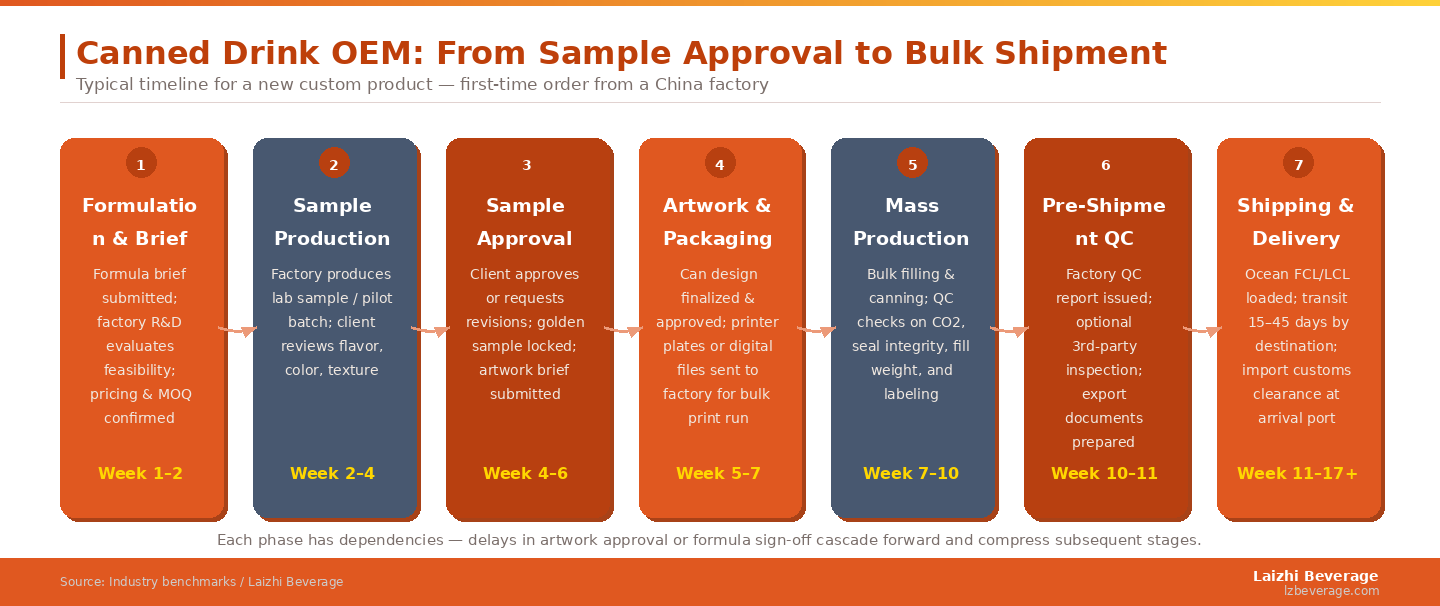
Phase-by-Phase Timeline Breakdown
Phase 1: Formulation Brief & Factory Quotation (Week 1–2)
The process begins when you submit a product brief to the factory — covering the beverage type, desired flavor profile, packaging format (can size, finish), target market, and approximate volume. A responsive OEM factory should acknowledge your inquiry and provide an initial feasibility response within 24–48 hours. Full quotation, including MOQ confirmation and a preliminary production schedule, typically follows within 3–5 business days. At Laizhi Beverage's HACCP-certified facility, the dedicated sales and R&D team evaluates briefs quickly so that custom canned beverage projects move from concept to sample stage without unnecessary waiting.
Phase 2: Sample Production (Week 2–4)
Once the formula parameters are agreed upon, the factory's R&D team produces a lab-scale or pilot sample. For carbonated canned drinks, this involves blending the base formula, carbonating at the specified CO₂ volume, filling into sample cans, and sealing. The full sample round — production, quality review, and courier shipping to the buyer — typically takes 7–14 days. Budget for at least one revision round, which adds another 5–10 days. Buyers who arrive with a detailed sensory brief (target sweetness, carbonation level, color, aroma notes) shorten this phase considerably.
Phase 3: Sample Approval & Golden Sample Lock-In (Week 4–6)
The sample approval stage is where schedules most commonly slip. Once you receive samples, you need time to taste-test, share internally, and respond with feedback. Quality control practitioners define the "golden sample" as the pre-approved prototype that becomes the master reference for all production batches — every unit produced must match it. Locking the golden sample before moving forward is non-negotiable; factories that skip this step create significant disputes later. Buyers who need regulatory review or marketing team sign-off before approval should factor in 2–4 extra days for internal coordination.
Phase 4: Artwork Finalization & Packaging Approval (Week 5–7)
Artwork for custom-printed cans is a parallel track that should ideally start during Phase 2, but cannot be finalized until after sample approval confirms the can size and format. The factory needs print-ready vector artwork in the correct template (matching the specific can diameter and height). Most factories require 3–5 business days to review artwork for technical compliance — checking ink coverage, color separations, and bar code readability — before issuing an approval. First-time buyers often underestimate this phase; inexperienced design agencies deliver files that require multiple rounds of correction.
Phase 5: Mass Production (Week 7–10)
With golden sample locked and artwork approved, the factory can schedule your production run. Co-packer benchmarks suggest that from approved formula to first bulk production typically spans 8–12 weeks total (including earlier phases), with the production run itself taking 2–4 weeks depending on order volume and line scheduling. For carbonated drinks in aluminum cans, production involves blending, carbonating, filling on high-speed canning lines, seaming the can lids, pasteurizing where required, labeling, and palletizing. Laizhi Beverage's 50 production lines with a daily capacity of one million cans allow flexible scheduling even for mid-size orders.
Phase 6: Pre-Shipment Quality Control (Week 10–11)
Before any shipment leaves the factory, a proper pre-shipment inspection should take place. The factory issues its own QC report covering fill weight, CO₂ pressure, seam integrity, label placement, and pallet configuration. Many buyers also commission a third-party inspection — services like SGS or Intertek typically require 1–2 days on-site and return a written report within 24 hours. Export documentation (commercial invoice, packing list, certificate of origin, HACCP certificate, and any market-specific certificates) is prepared simultaneously.
Phase 7: Ocean Freight & Delivery (Week 11–17+)
Ocean freight from China is the final and often longest leg. According to the Flexport Ocean Timeliness Indicator, in March 2026 transit times from China to the US West Coast averaged 37 days and to North Europe approximately 58 days — door-to-factory. For Southeast Asian destinations, transit is considerably shorter at 5–12 days. A detailed analysis of beverage supply chains highlights that port congestion, documentation errors, and peak-season scheduling are the three most common causes of shipment delays beyond the published transit window.
| Destination Region |
Ocean Transit (port-to-port) |
Estimated Door-to-Door |
| Southeast Asia |
5–12 days |
+7–10 days customs/inland |
| Middle East |
18–28 days |
+7–14 days customs/inland |
| North America (West Coast) |
15–22 days |
+10–14 days customs/inland |
| North America (East Coast) |
30–40 days |
+10–14 days customs/inland |
| Europe |
25–45 days |
+7–12 days customs/inland |
| Africa / South America |
30–55 days |
+14–21 days customs/inland |
Reorder Lead Times vs. First Orders
A key planning consideration is that reorders run on a dramatically shorter clock. Once your formula is on file, your golden sample is locked, and your artwork is approved, the factory can skip Phases 1–4 entirely. Bulk production can begin almost immediately after you place a purchase order and pay a deposit. Reorder production plus pre-shipment QC typically takes 2–3 weeks, bringing total door-to-door time (including shipping) to 5–9 weeks for most destinations — roughly half the time of the first order. This is why experienced beverage brands place their second order while still waiting for the first shipment to arrive.
Common Lead Time Killers to Avoid
Several factors consistently extend OEM timelines beyond the estimates above. Incomplete product briefs at the start of Phase 1 force the factory to make assumptions, which almost always leads to sample revisions. Slow internal decision-making during sample review — particularly when multiple stakeholders need sign-off — is the single biggest controllable variable. Submitting artwork in the wrong format (rasterized files instead of vector, or using embedded fonts that the factory cannot render) triggers additional rounds of artwork correction. Finally, forgetting to account for Chinese public holidays — particularly Chinese New Year, which shuts factories for 2–3 weeks in January or February — can delay orders by a full month if not planned around.
How to Build a Realistic Launch Timeline
Working backwards from your target on-shelf date is the most reliable approach. Start with your launch date, subtract the ocean transit time for your destination, then subtract 1–2 weeks for pre-shipment QC, then 3–4 weeks for mass production, then allow 2–4 weeks for artwork approval, then 2–4 weeks for sample approval (with buffer for one revision round), and finally 1–2 weeks for the initial brief and quotation stage. For a European brand targeting a Q3 shelf date, this calculation typically points to an initial factory contact in Q1 at the latest. Buyers who engage early, provide complete briefs, and appoint a single decision-maker for sample approvals consistently achieve the fastest timelines.
Frequently Asked Questions
How long does canned beverage OEM production take from start to finish?
For a first-time custom order, expect 10–17 weeks door-to-door, including sample development, mass production, and ocean freight. Reorders on approved formulas typically take 5–9 weeks total.
What causes the most delays in canned drink OEM lead times?
Sample revision rounds, slow artwork approval, and incomplete product briefs are the three leading causes. External factors — factory holiday shutdowns and port congestion — also add time that buyers often overlook in their planning.
Can I speed up the OEM process with air freight?
Air freight eliminates 3–5 weeks of ocean transit but significantly increases per-unit cost and is impractical for bulk orders of heavy canned goods. It is occasionally used for small press samples or urgent reorders of low-volume SKUs.
Does MOQ affect lead time for canned drinks?
Higher MOQs generally do not shorten production time significantly — the factory's planning, R&D, and sampling phases are independent of volume. Very large orders may require more production days, but small and mid-size orders often wait in the production queue regardless of quantity.
What is a golden sample and why does it matter for lead times?
A golden sample is the final approved prototype that serves as the master reference for all quality checks during bulk production. Agreeing on and formally signing off on a golden sample before production begins prevents disputes and rework — which would add weeks to your timeline.
Ready to get an accurate lead time estimate for your canned drink project? Learn about Laizhi Beverage's production capabilities and certifications — or contact our team directly to discuss your brief, MOQ, and target delivery date.


