The United States represents one of the world's largest import markets for canned beverages — and one of the most procedurally demanding. Importers sourcing canned drinks from China for the US market quickly learn that having a great product and a certified factory is necessary but not sufficient.
The United States represents one of the world's largest import markets for canned beverages — and one of the most procedurally demanding. Importers sourcing canned drinks from China for the US market quickly learn that having a great product and a certified factory is necessary but not sufficient. The factory itself must be registered with the US Food and Drug Administration before a single case of product can legally clear US customs. This requirement, rooted in the Public Health Security and Bioterrorism Preparedness and Response Act of 2002, catches many first-time importers by surprise mid-shipment.
Why we wrote this: We regularly work with OEM customers preparing for their first US shipment, and the FDA registration requirement is consistently the step that causes unexpected delays. This guide gives importers the complete picture — requirements, process, timelines, and the most common mistakes — so your launch timeline holds.
Key Takeaways
- Every overseas food facility shipping to the US must register with the FDA — this applies to all Chinese canned drink manufacturers regardless of factory size or shipment volume.
- FDA facility registration requires appointing a US-based agent who can receive regulatory notices on the facility's behalf — this is not optional.
- Registration must be renewed biennially (October through December in odd-numbered years) — lapsed registration is one of the most common causes of US customs holds for Chinese food products.
- FDA registration is separate from HACCP, ISO 22000 and Chinese export qualifications — each serves a different regulatory function and is required independently.
- Under FSMA's Foreign Supplier Verification Program (FSVP), US importers bear additional legal responsibility for verifying that their overseas factories meet FDA food safety standards.
Why FDA Registration Exists — The Regulatory Foundation
The Bioterrorism Act of 2002 established the requirement for all domestic and foreign facilities that manufacture, process, pack or hold food for US consumption to register with the FDA. This registration system — maintained through the FDA's FURLS (Food Facility Registration Module) — gives the agency a real-time list of every food facility supplying the US market and the legal authority to suspend registration of any facility that poses a food safety risk. The Food Safety Modernization Act (FSMA) of 2011 strengthened these requirements by mandating biennial renewal and expanding the FDA's authority to inspect registered facilities.
For Chinese canned drink manufacturers, FDA registration is not a quality certification — it is a legal prerequisite for market access. A factory with excellent HACCP and ISO 22000 credentials cannot legally supply the US market without it. The FDA has published detailed guidance on how overseas food facilities can complete registration, including the steps the agency took to facilitate registration for Chinese facilities under GACC Decree 248 requirements that took effect in 2022.
We have worked through the FDA registration process with our US-market customers and consistently find that the US agent step is where the most confusion arises. Several buyers have come to us with a factory recommendation only to discover the factory has never registered with the FDA — or registered years ago and let the biennial renewal lapse. Building FDA registration verification into the supplier qualification checklist, before purchase orders are placed, is the single most effective way to prevent last-minute US customs holds on canned drink imports.
Who Needs to Register — and Common Misunderstandings
Every facility that manufactures, processes, packs or holds food for US consumption must register — regardless of whether it exports directly to the US or supplies a US-bound product through an intermediary. This means:
- The canned beverage production factory itself must be registered
- A separate cold-storage or warehousing facility in China that holds finished goods destined for the US must also register
- A trading company or freight forwarder that only arranges logistics does not need to register
A common misunderstanding is that the US importer's own food facility registration covers the overseas factory. It does not. The factory itself must hold its own FDA registration number, and that number must be declared on US customs entry documents.
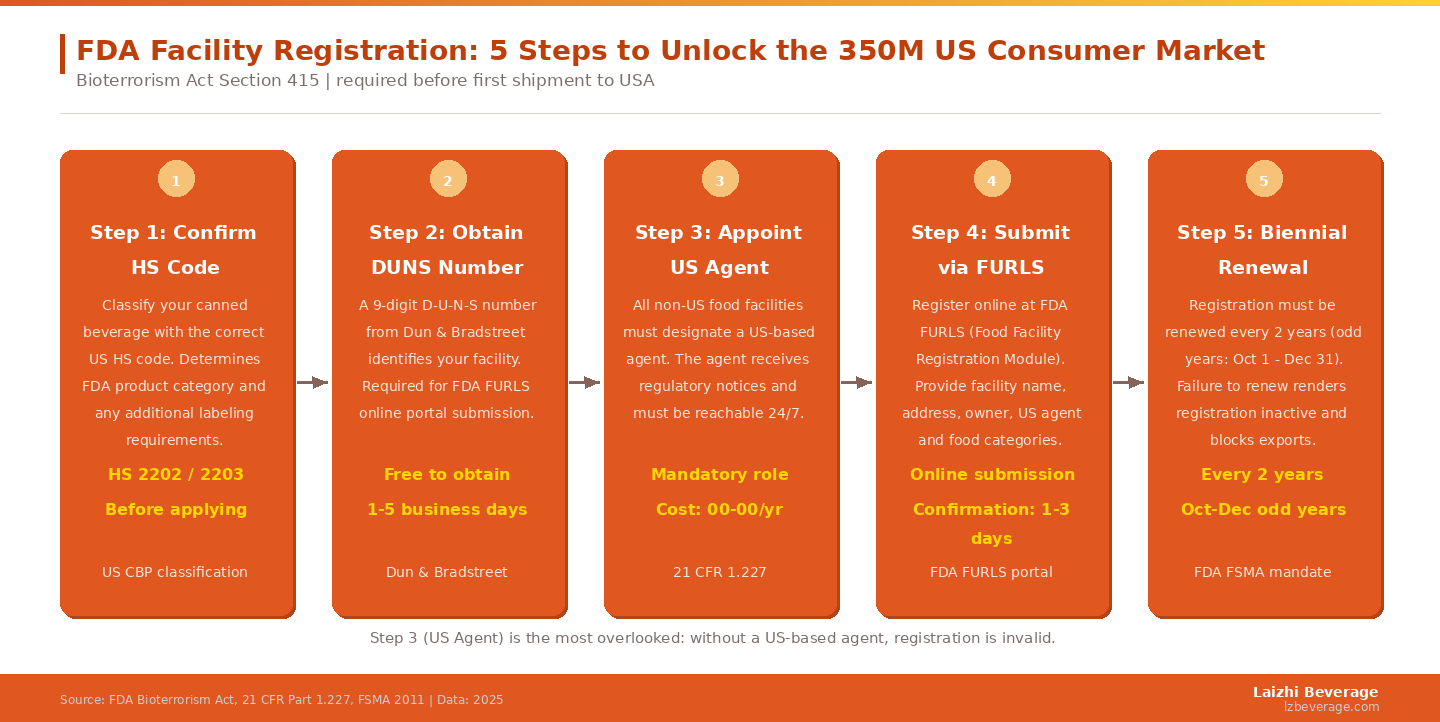
The 5-Step Registration Process
Step 1: Confirm Your HS Code and FDA Product Category
Identify the correct US Harmonized Tariff Schedule (HTS) code for your canned beverage. Carbonated soft drinks typically fall under HS 2202; beer under HS 2203; energy drinks may fall under 2106 or 2202 depending on formulation. The HTS code determines which FDA product category your shipment will be declared under and whether any additional import alerts or ingredient restrictions apply.
Step 2: Obtain a DUNS Number
A DUNS (Data Universal Numbering System) number from Dun & Bradstreet is required to create an account in the FDA's FURLS portal. DUNS numbers are free to obtain for most overseas businesses and typically take 1 to 5 business days to issue. The DUNS number is tied to the facility's physical address — if the factory relocates, a new application is needed.
Step 3: Appoint a US Agent
This is the step most often overlooked by first-time exporters. All non-US food facilities must designate a US-based agent who can receive regulatory notices, inspection requests, and emergency communications from the FDA on behalf of the facility. The US agent must be physically located in the United States and available 24 hours a day, 7 days a week for FDA contact. Numerous companies offer commercial US agent services, with annual fees typically ranging from $200 to $800 depending on the service scope. The agent's contact details are submitted as part of the registration and must be kept current — if the FDA cannot reach the US agent, the facility's registration can be suspended.
Step 4: Submit Registration via FDA FURLS
Once the DUNS number is obtained and the US agent is designated, the facility submits registration through the FDA FURLS online portal. The submission includes the facility name, address, owner or operator information, US agent details, and the categories of food products manufactured. Registration is typically confirmed within 1 to 3 business days. The facility receives an FDA registration number that must be maintained and referenced on all US-bound shipment documentation.
Step 5: Biennial Renewal
FDA food facility registrations must be renewed during the October 1 to December 31 window in every odd-numbered year (2025, 2027, etc.). Facilities that miss this renewal window have their registration automatically deactivated. Products from facilities with inactive registrations are subject to detention at US customs, which means physical holds, additional inspection fees and cargo delays of days to weeks. The renewal process is completed via the same FURLS portal and requires no fee, but does require confirming that all registration details remain accurate and the US agent remains in place.
FSVP: What the Importer's Responsibility Looks Like
Under FSMA's Foreign Supplier Verification Program (FSVP), US importers are not just passive recipients of overseas products — they bear legal responsibility for verifying that their foreign suppliers meet FDA food safety standards. In practice, this means US importers must conduct and document hazard analysis for each imported product, conduct supplier verification activities (which can include audits, testing or review of supplier certifications), and maintain records for at least five years. The USDA Foreign Agricultural Service maintains updated guidance on Chinese facility registration requirements and how they interact with US import procedures.
Common Mistakes That Hold Canned Drink Shipments at US Customs
Based on documented patterns in US customs holds for imported food products, the most frequent FDA-related causes are: lapsed biennial renewal (the factory simply missed the odd-year October-December renewal window), US agent information that is outdated or the agent is no longer reachable, mismatched facility names between the FDA registration and the commercial invoice, and product categories that are not listed in the facility's registration (e.g., a factory registered for beer that starts shipping energy drinks).
Any of these discrepancies can trigger an FDA import alert, which may apply to all shipments from that facility until the underlying issue is resolved — not just the problematic shipment. Importers should build an annual calendar reminder for their Chinese suppliers' FDA renewal windows and confirm the US agent's contact details remain active every 12 months. For OEM partners seeking a US market-ready supplier, we maintain current FDA registration and are happy to provide documentation upon request.
Next-step checklist
- Today: ask any Chinese factory you are sourcing from to provide their FDA registration number and the name of their designated US agent.
- Verify the registration at accessdata.fda.gov/scripts/fdcc/?set=FoodFacilities — confirm the facility name, address, and that registration is active, not deactivated.
- Before your first US shipment: ensure your own FSVP documentation is in place — hazard analysis, supplier qualification records, and a minimum 5-year record retention policy.
- Set a calendar reminder for October 2027 (next biennial renewal window) to follow up with your Chinese suppliers and confirm renewal has been completed.
FAQ
Does FDA registration cost money?
The FDA registration itself is free. The costs associated with the process are primarily for the US agent service (typically $200 to $800 per year) and any consulting support for completing the registration or FSVP compliance documentation. No government fee is charged for initial registration or biennial renewal.
What happens if a Chinese factory's FDA registration lapses?
The FDA will deactivate the registration. Products from a deactivated facility are subject to detention at US customs — meaning the shipment is physically held, cannot be cleared for delivery, and may require additional FDA review. The FDA can also issue an import alert for the facility, which broadens the detention to all future shipments until the registration is reinstated and verified. Reinstatement requires completing a new registration submission via FURLS.
Does FDA registration apply to canned beer exported to the US?
Yes. The FDA has jurisdiction over most food and beverage products imported into the United States, including beer and other alcoholic beverages, in coordination with the Alcohol and Tobacco Tax and Trade Bureau (TTB). All overseas facilities producing canned beer for US consumption must be FDA-registered. Importers of alcoholic beverages should additionally verify TTB requirements for specific label approvals.
How long does FDA registration take?
The online submission itself can be completed in one session, typically 1 to 2 hours. Confirmation of the registration number from the FDA usually arrives within 1 to 3 business days. Delays typically occur at the earlier steps — particularly obtaining the DUNS number or designating a US agent — rather than in the FDA portal itself. Allow 10 to 15 business days from the start of the process to account for all pre-submission steps.
Can a US importer complete FDA registration on behalf of their Chinese factory?
The registration must be submitted by or on behalf of the facility itself — not solely by the importer. The US agent can submit the registration on the facility's behalf, but the facility must authorize the submission and the registration is tied to the facility. Importers cannot register a facility independently. For more on how we support export compliance for OEM partners entering the US market, contact our sales team.


