Verifying a Chinese canned beverage factory before placing an order is not simply good practice — it is the single most effective way to protect your brand, your capital, and your supply chain. According to sourcing verification specialists, a 2024 QIMA compliance review found that 59 percent of Chinese factories audited passed compliance checks — which means more than 40 percent did not.
Verifying a Chinese canned beverage factory before placing an order is not simply good practice — it is the single most effective way to protect your brand, your capital, and your supply chain. According to sourcing verification specialists, a 2024 QIMA compliance review found that 59 percent of Chinese factories audited passed compliance checks — which means more than 40 percent did not. That gap illustrates why online profiles and sales conversations are never sufficient due diligence for a canned beverage OEM relationship. This guide covers every verification step in sequence, from free online checks you can do today to an on-site factory visit in China.
Key Takeaways
- Verification has six progressive levels — from a free 10-minute government database check to a full third-party audit and factory visit.
- All six steps can be completed remotely except Step 6 (on-site visit) — remote verification is adequate for most first orders below USD 30,000.
- Third-party audits cost USD 250–400 for a one-day factory inspection and are the single highest-return investment in the pre-contract phase.
- Factories that pass HACCP and GMP audits have documented food safety systems that protect both your product quality and your regulatory compliance.
- Any factory that refuses verification steps — video tours, audit access, or document review — should be removed from your shortlist immediately.
Why Verification Is Non-Negotiable for Canned Beverages
Canned beverages carry unique verification requirements compared to other manufactured goods. The product is consumed — which means food safety failures are not just financial; they are public health issues. GMP audit frameworks cover nine distinct categories of manufacturing practice, including raw material handling, sanitation, employee hygiene, equipment maintenance, and finished product testing — all of which directly affect whether your canned drink is safe and shelf-stable for its claimed lifespan. A factory that looks organized on a video call but lacks documented GMP systems creates significant liability for any brand selling under its name.
Additionally, canned beverages sold internationally must meet destination-market food safety standards. Certification auditors note that HACCP, ISO 22000, and BRCGS certifications are the primary gatekeepers for regulated markets — and a factory that cannot substantiate its certifications with actual documents and recent audit reports is not export-ready, regardless of what its sales team claims.
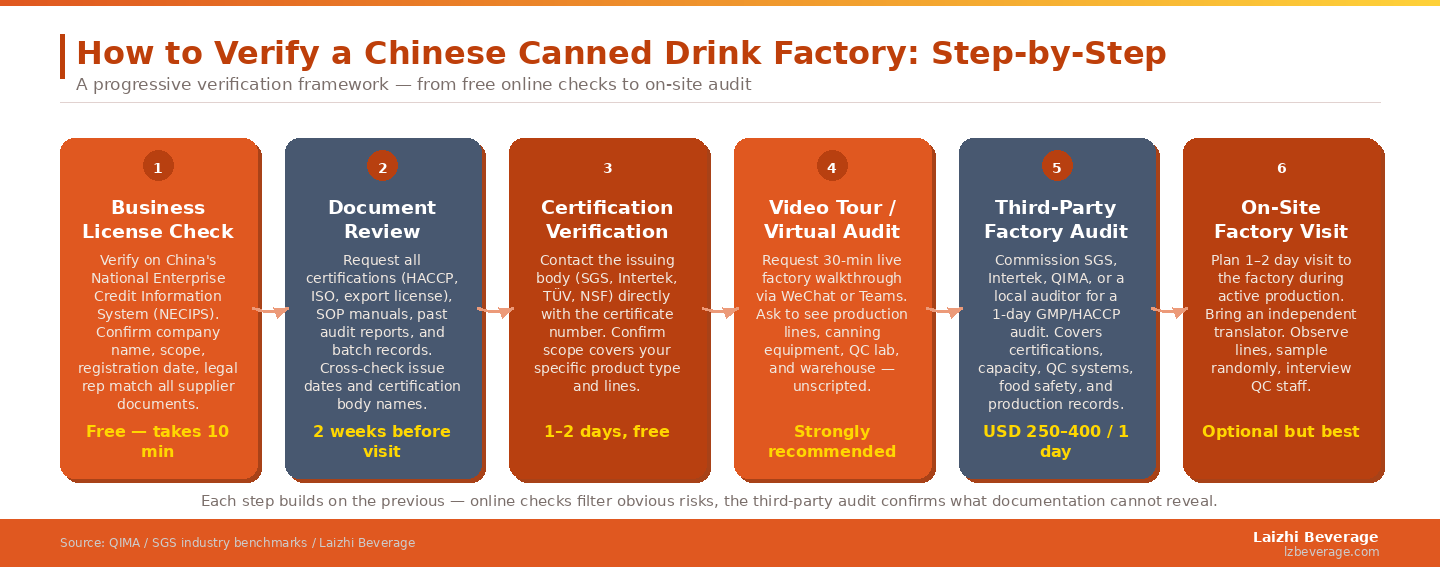
Step 1: Business License Verification (Free, 10 Minutes)
Every legitimate Chinese company must hold a government-issued business license (营业执照). The license records the company's legal name in Chinese, registered address, business scope, establishment date, legal representative, and registered capital. You can verify this information for free at China's National Enterprise Credit Information Publicity System (NECIPS) — search by Chinese company name or unified social credit code. Check that the company name on the license matches exactly what appears on all supplier invoices, certificates, and correspondence. Any inconsistency is a serious red flag. Supplier verification guides advise confirming that the business scope listed on the license includes food production or food processing — a company registered only for trading cannot legally manufacture food products in China.
Step 2: Document Collection and Pre-Review (2 Weeks Before Visit)
Factory audit best practices recommend requesting all relevant documents at least two weeks before any scheduled visit or audit. For a canned beverage OEM factory, the document package should include: the food production license, current HACCP or ISO 22000 certificate with issuing body details, export registration certificate if applicable, most recent third-party audit report (within the past 12 months), standard operating procedures for key production processes, and sample batch records or Certificates of Analysis from recent production runs. Reviewing these in advance allows you to enter any subsequent audit or visit with specific questions about gaps or inconsistencies, rather than spending audit time on basic document collection.
Step 3: Certification Verification with Issuing Bodies (1–2 Days, Free)
Counterfeit certification documents are a real and well-documented risk in Chinese manufacturing. The only way to verify a certificate is legitimate is to contact the issuing body directly — not to accept the document at face value. Most HACCP, ISO, and GFSI-scheme certifications can be verified online through the certification body's public database, or by emailing their customer verification service with the certificate number and scope. Verify three things: that the certificate is current (not expired), that it covers the specific factory location (not a different site), and that the scope includes the product categories relevant to your order. International due diligence specialists note that certificate fraud often involves real certificate numbers applied to wrong facilities or product scopes — verification with the issuing body catches this precisely because it goes beyond visual document review.
Step 4: Video Factory Tour or Virtual Audit
A live video walkthrough of a factory, conducted via WeChat Video, Teams, or Zoom, is the most accessible remote verification tool available. Request a 30-minute unscripted tour covering the canning production lines, filling equipment, QC laboratory, raw material storage, and warehouse. Ask the person conducting the tour to walk you through the lines in sequence — unscripted tours reveal operational reality in ways that pre-planned presentations cannot. Ask them to show you the QC log board, the current production schedule, and a randomly selected batch record. Factory visit guides emphasize that any factory citing technical problems, scheduling constraints, or confidentiality concerns as reasons to avoid a live video tour should be treated with suspicion — a legitimate operation has nothing to hide from a prospective buyer.
What to Look for in a Video Tour
Specific signals worth watching for during a video tour include the cleanliness and organization of production areas (a GMP-compliant facility has distinct zones for different production stages), the condition and age of canning equipment, whether workers are wearing appropriate hygiene attire (hairnets, gloves, aprons), whether raw materials are properly labelled and stored separately from finished goods, and whether a QC testing area is visible and actively in use. A factory like Laizhi Beverage, with 50 dedicated production lines and HACCP certification, can demonstrate all of these elements in a standard facility walkthrough because their quality systems are built into daily operations.
Step 5: Third-Party Factory Audit (USD 250–400, 1 Day)
A third-party factory audit conducted by an independent inspection agency is the most definitive pre-contract verification step short of visiting yourself. Supplier audit specialists describe a standard audit as covering legal verification, certification authentication, production capacity assessment, QC system review, food safety practices, labor conditions, environmental compliance, and the match between the factory's stated capabilities and its actual operations. Agencies like SGS, Intertek, QIMA, Bureau Veritas, and Pro QC International all offer food manufacturer audits specifically designed for buyers sourcing from China. These services typically cost USD 250–400 for a one-day on-site visit and return a written report with photographs within 24–48 hours.
For canned beverages specifically, a GMP/HACCP audit is the most relevant type. Request that the auditor confirm: whether the HACCP plan covers the specific beverages in your order, whether the canning lines are in GMP-compliant condition, whether CO₂ handling and carbonation systems are properly managed and documented, and whether the factory has procedures for allergen control, cleaning validation, and pest control — all of which are standard HACCP requirements for beverage production.
| Audit Type |
What It Covers |
Cost Range |
Best For |
| Business Verification Audit |
Legal status, ownership, premises existence |
USD 100–200 |
First-time supplier check |
| GMP/HACCP Compliance Audit |
Food safety systems, production practices, certifications, QC documentation |
USD 250–400 |
Food/beverage OEM verification |
| Social Compliance Audit |
Labor practices, working conditions, environmental policies |
USD 350–600 |
Brands with ESG/CSR requirements |
| Full Factory Capability Audit |
All of the above plus production capacity, equipment condition, export logistics |
USD 500–900 |
Large orders, long-term partnerships |
Step 6: On-Site Factory Visit (Optional, Highest Confidence)
For orders above USD 30,000, ongoing supply relationships, or any situation where the factory will be named on your product's origin documentation, an on-site visit is worth the investment. Factory visit guides recommend applying for a Chinese business visa (Type M or F) at least three to four weeks in advance, and scheduling the visit during active production of the type of product you intend to order — not during a holiday or downtime period. Bring an independent translator hired separately from the factory, rather than using whoever the factory offers. During the visit, prioritize: observing the actual canning lines in operation, reviewing a live batch record, randomly selecting a finished product from the warehouse to inspect against your approved golden sample specs, and speaking directly with the QC manager rather than only the sales team.
What Passing Each Step Looks Like
A factory that successfully passes all six verification steps has demonstrated: legal existence and good standing (Step 1), complete and internally consistent documentation (Step 2), current certifications verified with issuing bodies (Step 3), transparent facility operations visible via video (Step 4), a clean or passing third-party audit report covering HACCP and GMP (Step 5), and organized, well-managed production observed in person (Step 6). No legitimate factory fails all six of these steps simultaneously — and any factory that blocks verification at multiple points should be immediately disqualified regardless of how competitive its pricing or samples appear.
Frequently Asked Questions
Do I need to visit China in person to verify a canned drink factory?
No — for most first orders, Steps 1 through 5 provide sufficient verification and can all be completed remotely. A third-party auditor visiting on your behalf gives you an independent assessment equivalent to most of what a personal visit would reveal. Personal visits become essential for long-term supply relationships and orders above USD 30,000–50,000.
How long does factory verification take from start to finish?
Steps 1–3 can be completed in 3–5 business days. Scheduling and completing a third-party audit (Step 5) typically takes 7–14 days from inquiry to written report. A personal factory visit (Step 6) requires 3–4 weeks of planning for visa processing. The full process from first inquiry to verified readiness takes approximately 2–4 weeks depending on factory responsiveness.
Which certification matters most for exporting canned drinks from China?
HACCP is the baseline — it is required or strongly expected by food safety authorities in most international markets. For the EU, ISO 22000 or FSSC 22000 provides stronger standing. For US FDA compliance, the factory must hold FDA Facility Registration and follow FSMA Preventive Controls rules. For the UK post-Brexit, BRCGS certification is the most widely recognized standard among major retailers.
Can I use the same audit report for multiple orders from the same factory?
Audit reports are typically valid for 12 months from the inspection date, though major changes to ownership, facility, or production scope should trigger a new audit. For ongoing supply relationships, most experienced buyers commission annual re-audits as standard practice.
Browse Laizhi Beverage's full canned beverage OEM range — or review the factory's HACCP certification, production capacity, and export credentials as your starting point for verification.


