The private label food and beverage market is projected to grow from USD 255.9 billion in 2025 to USD 393.6 billion by 2034, and a significant portion of that production flows through Chinese OEM factories. Yet for every brand that successfully launches a canned beverage through a Chinese manufacturer, another gets burned by skipping the one step that could have prevented it: a properly structured sample request. Requesting a sample is not as simple as emailing "send me something to try."
The private label food and beverage market is projected to grow from USD 255.9 billion in 2025 to USD 393.6 billion by 2034, and a significant portion of that production flows through Chinese OEM factories. Yet for every brand that successfully launches a canned beverage through a Chinese manufacturer, another gets burned by skipping the one step that could have prevented it: a properly structured sample request. Requesting a sample is not as simple as emailing "send me something to try." Done correctly, it is a formal due-diligence process that filters out unreliable suppliers, protects your intellectual property, and dramatically reduces the risk of a costly first bulk order.
Key Takeaways
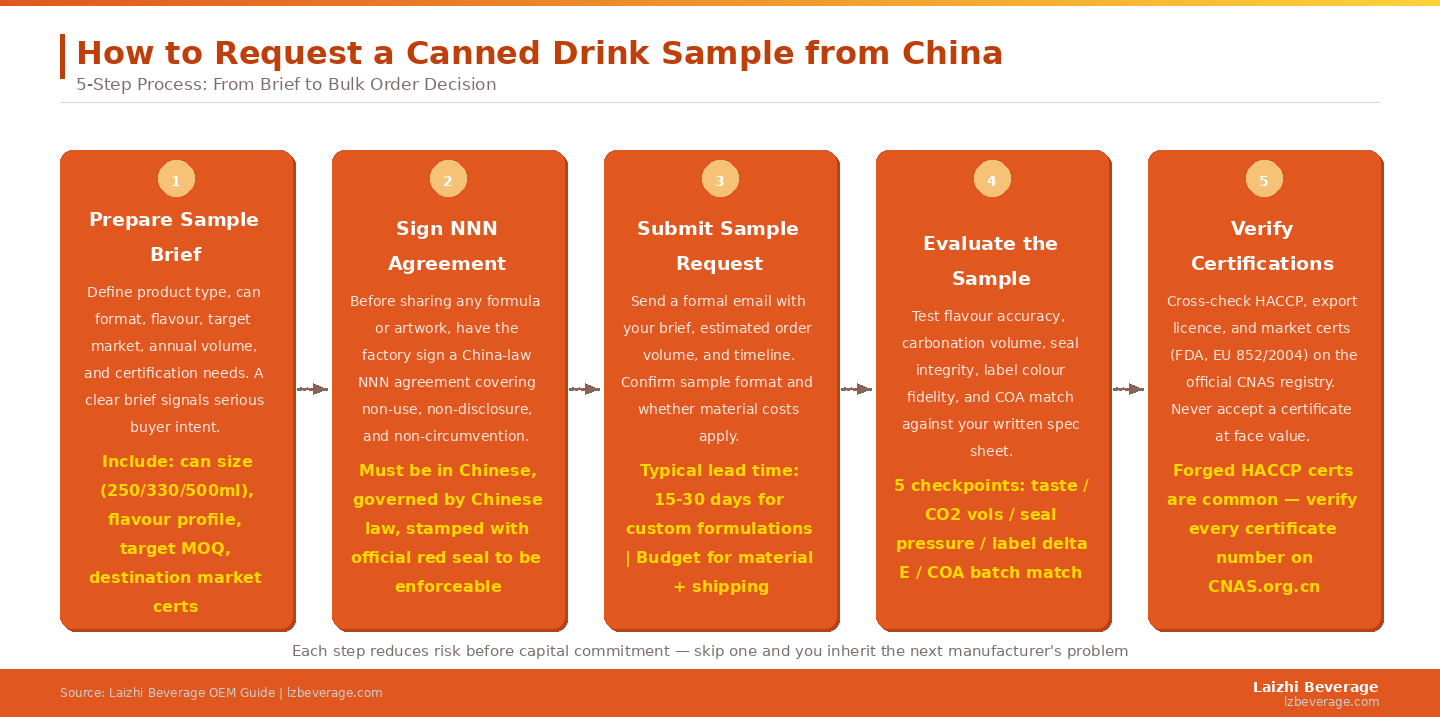
- A sample brief is a business document, not a casual message — it signals seriousness to the factory and anchors your evaluation criteria before anything is poured.
- Sign a China-enforceable NNN agreement before sharing any formula or artwork — a standard Western NDA provides limited protection under Chinese law.
- Typical sample lead times run 15–30 days for custom formulations; budget for material and shipping costs even if the factory advertises "free samples."
- Certification verification is non-negotiable — HACCP certificates in China can be forged, and the only reliable check is the official CNAS registry.
- Evaluate samples against a written spec sheet, not against memory or general impression — a five-point checklist prevents subjective approval of a product that will fail QC at scale.
Why Sampling Is Non-Negotiable Before Any OEM Order
Many first-time buyers treat sampling as a courtesy step — a nice-to-have before committing to a minimum order quantity. In reality it is the cheapest insurance policy available. A properly evaluated sample tells you whether the factory's production line can hit your carbonation target, whether their sealing process survives a 48-hour pressure test, and whether their in-house printing matches the artwork file you supplied. These are not things a datasheet or a WeChat video tour can confirm.
What a Sample Reveals That a Specification Sheet Cannot
Specification sheets describe a factory's theoretical capability. A physical sample tests actual output. Common gaps that only emerge at the sample stage include inconsistent CO2 volumes across cans from the same batch (a sign of calibration drift on the filling line), label colours that shift under UV exposure, and can seam integrity failures that appear only when the product is stored at tropical temperatures — a critical concern for Southeast Asian and Middle Eastern distribution. For buyers launching a canned beer or energy drink, these variables directly determine whether your product clears customs inspection in the destination market. You can review Laizhi Beverage's production and quality control standards to understand what a factory with genuine export experience documents at each production stage.
Step 1 — Prepare a Professional Sample Brief
A sample brief is the first document a manufacturer uses to assess whether you are a serious buyer. Factories receive dozens of informal enquiries weekly; a structured brief moves yours to the top of the response queue and eliminates ambiguity that leads to off-target samples.
The 6 Pieces of Information Every Manufacturer Needs
Your sample brief should cover: (1) product category — beer, energy drink, RTD coffee, sparkling juice, or carbonated soft drink; (2) can format — specify volume (250 ml, 330 ml, 500 ml) and can type (standard, sleek, stubby, slim); (3) flavour profile — a tasting reference or brief flavour description, not just a name; (4) target market — the destination country determines label language, additive limits, and required certifications; (5) estimated annual volume — factories size their samples to anticipated production scale; (6) certification requirements — list HACCP, FDA, EU, HALAL, or market-specific certifications upfront. Factories that cannot confirm compliance at this stage are automatically disqualified before you invest in sampling costs. Browse the full Laizhi product range to understand the category coverage available from a certified OEM partner before drafting your brief.
Step 2 — Protect Your Formula Before Sharing Details
Before emailing a single ingredient ratio or sharing a label design file, you need a signed confidentiality agreement — and in China, the type of agreement matters significantly more than most buyers realise.
NDA vs. NNN: Which to Sign When Sourcing from China
A standard Western Non-Disclosure Agreement (NDA) protects against disclosure of your information to third parties, but it does not prevent a Chinese factory from using your formula to launch their own competing product or from sub-contracting your work to a lower-cost facility without your knowledge. According to sourcing specialists who document these distinctions, China-specific NNN agreements add two layers of protection beyond the NDA: Non-Use (the factory cannot use your IP for any purpose beyond your order) and Non-Circumvention (the factory cannot sell the same product directly to your customers or compete with you using your own formulation). Critically, this agreement must be written in Chinese, governed by Chinese law, and stamped with the factory's official red seal to be enforceable in a Chinese court. As manufacturing contract specialists in China confirm, an English-language NDA filed under foreign law is nearly impossible to enforce against a Chinese entity.
Step 3 — Contact the Manufacturer and Submit Your Request
Once your brief is ready and the NNN is signed, submit your sample request through a formal channel — ideally a direct email to the factory's export or sales department rather than a B2B platform messaging system. Platform messages are treated as low-priority enquiries; a professional email with your brief attached signals a different level of seriousness.
What a Strong Sample Request Email Should Include
Structure your email around four elements: a concise company introduction (who you are, where you operate, what brands you run or plan to launch); a clear statement of what you need sampled (reference your attached brief); your evaluation timeline and decision date; and explicit acknowledgement that you understand sample lead times are typically 15–30 days and that you are prepared to cover reasonable material costs. Asking for a free sample with zero context is the fastest way to land in a low-priority queue. According to industry sourcing guidance, demonstrating realistic order intent upfront — including a reference to your target MOQ — is the single biggest factor in whether a factory prioritises your sample request.
Step 4 — Evaluate the Sample Against Your Spec Sheet
When the sample arrives, evaluate it against the written spec sheet you submitted — not against your general impression of whether it "tastes good." Subjective approval at the sample stage is the root cause of most first-order quality disputes.
The 5-Point Tasting and Quality Checklist
| Checkpoint |
What to Test |
Pass / Fail Criterion |
| 1. Flavour Accuracy |
Taste blind against your reference sample or brief |
Matches stated flavour profile; no off-notes or metallic aftertaste |
| 2. Carbonation Level |
Check CO2 volumes (vols) against spec — use a calibrated gauge or lab test |
Within ±0.2 vols of the stated target across 6 cans minimum |
| 3. Seal Integrity |
Pressure test and visual seam inspection; store at 38°C for 48 hours |
Zero leakage, no deformation, no bulging at elevated temperature |
| 4. Label Accuracy |
Compare printed label colour against your design file (Pantone reference) |
Colour delta E ≤3; no text truncation, font substitution, or misregistration |
| 5. COA Match |
Request Certificate of Analysis for the sample batch; verify against your spec sheet values |
Brix, pH, microbiological counts, and preservative levels all within declared ranges |
Step 5 — Verify Certifications Before You Commit
A factory that produces excellent samples but holds invalid or expired certifications can block your entire shipment at the port of entry. Certification verification is not a trust exercise — it is a database lookup.
Which Certifications Matter Most for Export Markets
HACCP (Hazard Analysis and Critical Control Points) is the baseline certification for any Chinese beverage factory targeting export markets. As China-specific business verification services note, HACCP certificates in China are issued only by CNAS-accredited bodies, and the certificate number can be cross-referenced on the CNAS website. Forged certificates are common enough to make manual verification essential. For US-destined products, FDA facility registration is mandatory. For EU markets, compliance with EU Regulation (EC) No 852/2004 — which requires HACCP-based food safety procedures — is a minimum entry requirement. Understanding how a manufacturer structures their quality management from raw materials through to finished cans is the most reliable signal of certification authenticity. You can explore Laizhi Beverage's certified OEM energy drink production as a reference point for what a HACCP-compliant, export-ready canned beverage programme looks like in practice.
Common FAQs
How much does it cost to get a canned beverage sample from a Chinese manufacturer?
Costs vary by factory and customisation level. Blank-can samples using existing formulations are sometimes provided free of charge, though you will typically pay international shipping (USD 50–150 via DHL). Custom formulation samples — where the factory develops a new recipe or uses your proprietary formula — generally require a sample fee of USD 100–500 to cover ingredient testing and setup time, plus shipping. Treat this cost as part of your sourcing budget, not an obstacle.
How long does it take to receive a canned beverage sample from China?
Standard lead time for custom formulation samples is 15–30 days from confirmed brief and signed NNN. Factories with existing beverage formulas and standard can formats can sometimes turn samples in 7–10 days. Add 3–5 business days for international courier transit. Build at least 6 weeks into your project timeline to allow for one revision round if the first sample requires adjustments.
Can I request samples in my final can format (250 ml, 330 ml, 500 ml)?
Yes. Reputable OEM factories can produce samples in any standard can format they run in commercial production. Always confirm that the sample can size matches your intended commercial format — testing in a surrogate size introduces variables that can invalidate your evaluation.
What happens if the sample passes but the bulk order fails QC?
This is the most common complaint in canned beverage OEM sourcing. It happens when the sample is produced on a separate line, with greater care, than the commercial batch. To mitigate this risk: negotiate pre-shipment inspection (PSI) rights, specify that a third-party inspector (SGS, Bureau Veritas, or equivalent) may audit the production run at your discretion, and include COA matching as a contractual delivery condition. A factory that refuses PSI clauses at the contract stage is a factory worth avoiding, regardless of how good the sample tastes.
Do I need a lawyer to draft the NNN agreement?
For high-value or proprietary formulas, yes — engaging a law firm experienced in Chinese commercial law is strongly recommended. For initial exploratory sampling where no proprietary formula is shared, a reputable template signed by both parties and stamped with the factory's official seal provides a reasonable baseline. As China manufacturing specialists advise, the key is ensuring the agreement is written in Chinese and enforceable under Chinese law — not merely translated from an English template.


