The private label beverage market reached USD 255.9 billion in 2025 and is forecast to grow to USD 393.6 billion by 2034, driven partly by the surge in demand for carbonated energy drinks, sparkling waters, hard seltzers, and premium sodas. Behind most of those products is an OEM factory — a manufacturer who produces the beverage to the brand owner's specification and ships it under the brand's own label.
The private label beverage market reached USD 255.9 billion in 2025 and is forecast to grow to USD 393.6 billion by 2034, driven partly by the surge in demand for carbonated energy drinks, sparkling waters, hard seltzers, and premium sodas. Behind most of those products is an OEM factory — a manufacturer who produces the beverage to the brand owner's specification and ships it under the brand's own label. If you are exploring how to launch a sparkling beverage, understanding the OEM model is not optional background reading. It is the foundational decision that determines your cost structure, your timeline, your product quality ceiling, and your intellectual property position before your first can is filled.
Key Takeaways
- OEM (Original Equipment Manufacturer) means you own the formula; the factory produces it — giving you maximum control over recipe, ingredients, and product positioning.
- ODM (Original Design Manufacturer) means the factory owns an existing formula you licence and customise — faster to market, lower upfront cost, but limited differentiation.
- For carbonated beverages, one-stop OEM/ODM factories offer the greatest advantage — they handle formulation, carbonation, filling, canning, and export in a single facility. According to China business verification specialists, confirming a factory's HACCP certificate against the CNAS national registry is an essential step before committing to any production agreement.
- A China-enforceable NNN agreement is essential before sharing any proprietary formula — standard NDAs offer limited protection under Chinese law.
- HACCP certification and export qualifications are the minimum entry requirements for supplying US, EU, and most Asia-Pacific markets.
OEM vs. ODM vs. White Label: Which Model Fits Your Brand?
Three models govern most sparkling beverage brand launches through Chinese manufacturers. Understanding the differences before you contact a factory determines which conversations you need to have and which risks you need to manage.
The Three Manufacturing Models Explained
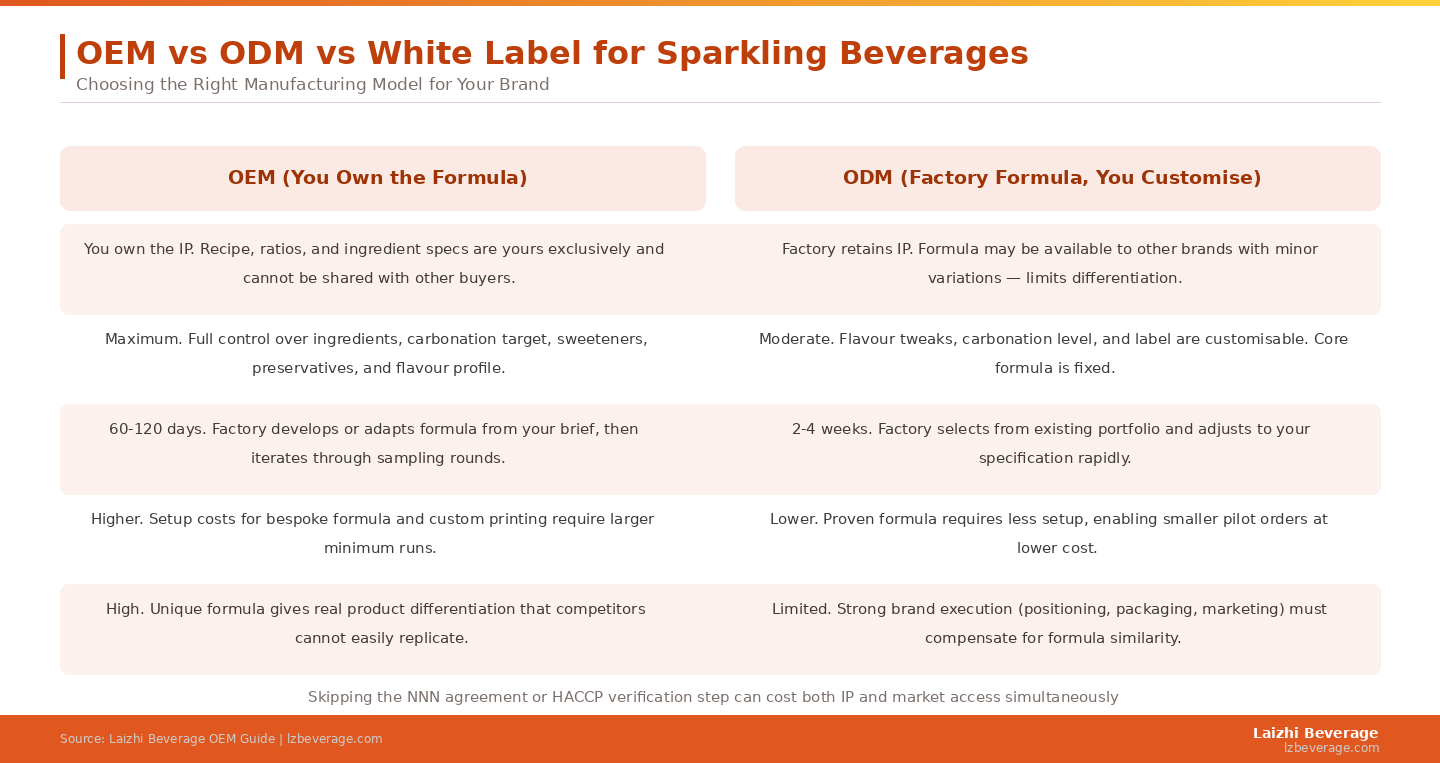
OEM (Original Equipment Manufacturer): You develop or own the formula, and the factory produces it to your exact specification. The recipe, formula ratios, ingredient sources, and carbonation targets belong to you. The factory provides the production line, equipment, and quality systems. This model gives you full differentiation and IP ownership, but requires a longer development timeline (typically 60–120 days from brief to production-ready formula) and sometimes a higher MOQ to justify setup costs.
ODM (Original Design Manufacturer): The factory already has a library of proven formulas. You select one, make minor adjustments (flavour tweaks, carbonation level, sweetener substitution), and launch it under your brand. As China manufacturing specialists note, ODM suits buyers who need rapid market entry with limited R&D investment, but it carries the risk that the same base formula is available to other buyers — which can undermine brand differentiation in competitive markets.
White Label: The factory produces an existing product exactly as-is, and you apply your brand label. Zero customisation. Fastest time to market, lowest upfront cost, but the same product can appear in competitors' portfolios. Suitable for market testing only, not for building a defensible brand.
For most brands launching carbonated beverages with genuine market ambitions, the OEM model — or an ODM arrangement with sufficient customisation — is the appropriate choice. You can explore how Laizhi Beverage's full OEM product range covers the main carbonated categories, from energy drinks to RTD sodas, to understand what customisation is possible within an established production environment.
What Makes Carbonated Drink OEM Uniquely Complex
Sparkling beverages introduce technical variables that still-liquid or powder OEM orders do not. A manufacturer producing a carbonated drink must control CO2 volumes with ±0.2 vol/vol precision, maintain counter-pressure filling lines to prevent CO2 loss during canning, manage can pressure ratings against the formula's carbonation level, and verify seam integrity at every production run. A factory that produces excellent juice or energy drink but has never managed high-carbonation filling is not equipped for your sparkling water brand — regardless of their certifications. Vetting a factory's specific experience with carbonated canned products is a distinct step in your supplier qualification process.
Certifications That Matter for Carbonated Beverage Export
For carbonated beverage OEM intended for export, the minimum certification stack is: HACCP — the globally recognised food safety management system that is legally required for food and beverage importers in the US (FDA), EU (Regulation 852/2004), and Canada. Export qualification from China's GACC (General Administration of Customs) — required for any food product leaving China through official channels. ISO 9001 for quality management — not legally mandatory but expected by professional buyers. FSSC 22000 or BRC Global Standard for Food Safety — increasingly requested by supermarket chains and large distributors as entry criteria. A factory that cannot provide verifiable, CNAS-registry-traceable HACCP certification is not an export-ready OEM partner.
Step-by-Step: How to Launch a Sparkling Beverage Brand Through an OEM Factory
The typical launch timeline for a new carbonated canned beverage brand through a Chinese OEM runs 4–6 months from brief to first commercial shipment. The steps below are the minimum required to reach a production-ready product without a major setback along the way.
| Step |
Action |
Typical Timeline |
| 1 |
Define product brief: category, can format, carbonation target, flavour profile, target market, MOQ |
Week 1 |
| 2 |
Sign NNN agreement with shortlisted factories (must be in Chinese, governed by Chinese law) |
Week 1–2 |
| 3 |
Request and evaluate samples — test carbonation, flavour, seal integrity, and COA |
Week 3–7 |
| 4 |
Verify certifications on CNAS registry; confirm export qualification and FDA/EU compliance |
Week 5–6 |
| 5 |
Finalise product spec sheet: CO2 vol/vol target, fill weight, label artwork, nutritional panel |
Week 7–8 |
| 6 |
Sign OEM production agreement with rework liability, PSI rights, and COA delivery conditions |
Week 8–9 |
| 7 |
Production run — book pre-shipment inspection when 80–100% complete and packed |
Week 10–18 |
| 8 |
PSI pass → release final payment → arrange export logistics and customs documentation |
Week 18–22 |
Choosing the Right Factory for Carbonated Beverage OEM
The factory qualification criteria for a carbonated beverage OEM are more specific than for a still drink. Beyond the standard certification and capacity checks, look for: dedicated counter-pressure filling lines (not repurposed still-drink lines); in-house carbonation mixing equipment with documented vol/vol calibration records; seam integrity testing capability (seam projector, not just visual inspection); and documented experience producing the specific category you are launching — canned beer, canned energy drink, and canned sparkling water all require different line configurations and process knowledge. Review Laizhi Beverage's 50-line production facility and HACCP-certified production standards as a reference for what a factory qualified for export-oriented carbonated OEM looks like. To begin a conversation about your specific carbonated beverage project, Laizhi's energy drink OEM programme is a practical starting point for buyers in the most competitive canned carbonated category.
Common FAQs
What is the minimum order quantity for carbonated drink OEM from China?
MOQ varies by factory and product type. For standard carbonated canned beverages (energy drinks, sodas, sparkling water), typical MOQs range from 5,000 to 50,000 units per SKU. Factories with flexible split-shipment models may allow you to commit to the full packaging print run (which has its own MOQ driven by printing costs) while scheduling multiple smaller production batches against it. Ask any factory about split-shipment options if your projected volumes are below their stated MOQ.
Can I protect my sparkling beverage formula when working with a Chinese OEM?
Yes — with the right legal structure. As China sourcing specialists confirm, a properly drafted NNN agreement written in Chinese and governed by Chinese law provides meaningful IP protection. It must be signed before you share any formula details, and it should explicitly cover non-use (the factory cannot apply your formula to other products), non-disclosure, and non-circumvention (the factory cannot supply your formula to your customers directly). IP protection in China has improved significantly over the past decade, and enforceable Chinese-language contracts are the standard tool.
How is OEM different from contract manufacturing for sparkling beverages?
In practice, the terms overlap. "Contract manufacturing" is often used to describe a full-service arrangement where the factory contributes to product development, while "OEM" typically implies the buyer brings a complete specification and the factory executes it. For carbonated beverages where most buyers do not have in-house food scientists, the line blurs — many Chinese OEM factories offer formulation support as part of the OEM engagement, effectively functioning as hybrid OEM/contract manufacturers.
How long does it take to launch a new carbonated drink brand through a Chinese OEM?
The realistic timeline from initial brief to first commercial shipment is 4–6 months for a new custom formula, or 6–10 weeks for an ODM product requiring only label and minor flavour customisation. The main variable is the sample approval cycle — if the first sample requires significant reformulation, each revision round adds 2–3 weeks. Buyers who provide a precise, written product brief from the first contact typically reduce their sample approval cycle by 30–50%.


