The global energy drink market is no longer riding a simple caffeine wave. In 2026, it sits at an estimated $83–91 billion in annual revenue — depending on the research methodology — with projections pointing toward $157 billion or more by 2034. Behind these figures are structural shifts in consumer behavior, packaging preferences, and the geography of growth that matter far more to brand builders than the headline number itself.
The global energy drink market is no longer riding a simple caffeine wave. In 2026, it sits at an estimated $83–91 billion in annual revenue — depending on the research methodology — with projections pointing toward $157 billion or more by 2034. Behind these figures are structural shifts in consumer behavior, packaging preferences, and the geography of growth that matter far more to brand builders than the headline number itself.
What you'll get from reading this: A data-grounded picture of where the energy drink can market stands in 2026, which regional dynamics are actually moving the needle, and what the sugar-free and functional beverage transition means for brands sourcing canned products through OEM manufacturing partnerships.
Key Takeaways
- The global energy drinks market is worth $83–91B in 2026, growing at 7.3–8.26% CAGR — consensus across multiple research firms puts the trajectory firmly upward through 2034.
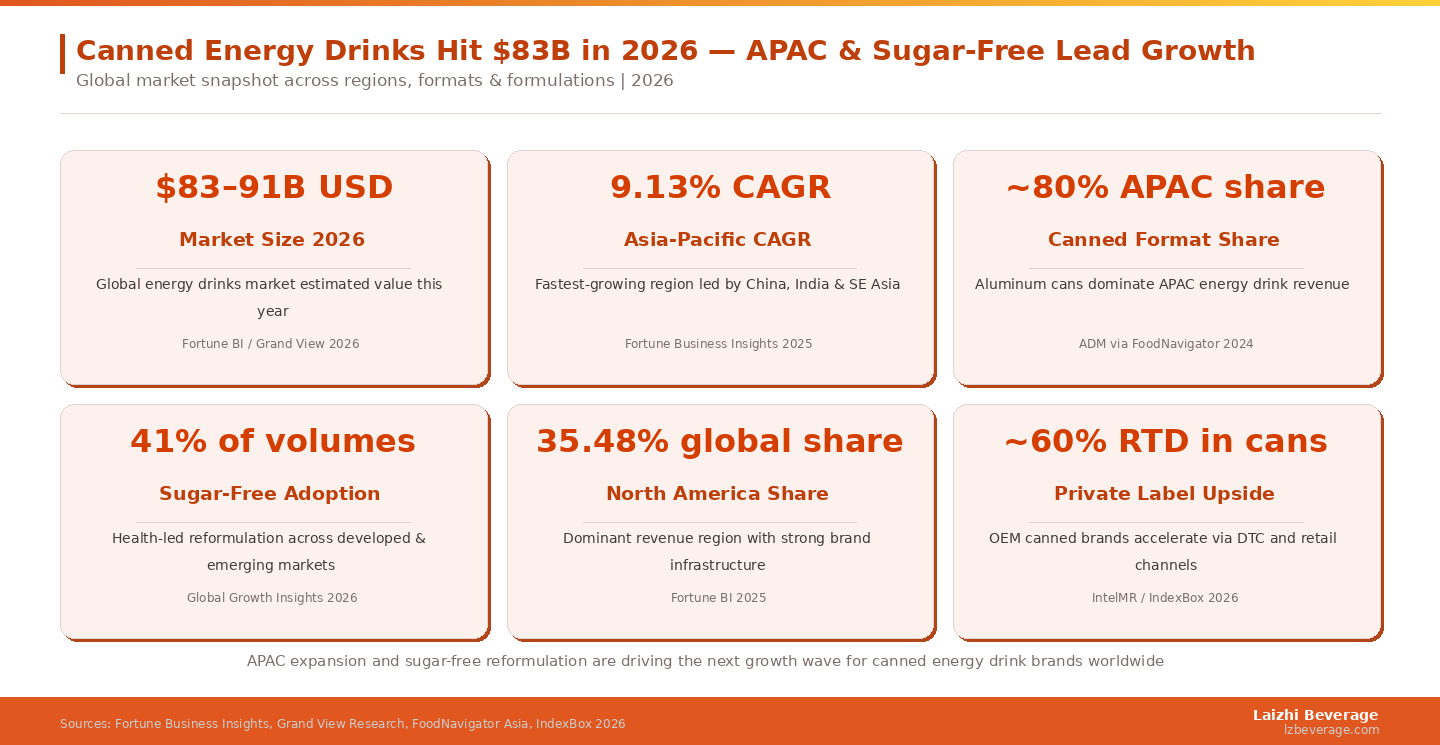
- Asia-Pacific is the fastest-growing and largest-volume region, with an 8.71–9.13% CAGR and canned formats capturing approximately 80% of APAC energy drink revenue.
- Sugar-free and functional reformulation is no longer optional — 41% of energy drink volumes are already sugar-free, and 70% of APAC consumers report concern about sugar in beverages.
- Aluminum cans dominate the packaging story, capturing over 96% of beverage can material share and accelerating into slim and sleek formats that align with on-the-go consumption.
- Private label and OEM-manufactured brands are gaining shelf space, particularly as cost-conscious retailers and DTC-first brands seek flexible, lower-MOQ manufacturing options.
How Big Is the Global Energy Drink Can Market in 2026?
Market Size: Reading the Range Honestly
Multiple research firms offer different 2026 baseline estimates for the global energy drinks market: Grand View Research puts it at $91.98 billion; Fortune Business Insights at $83.31 billion; Straits Research at $114.74 billion. The variation reflects differences in scope — some include energy shots, some exclude certain geographies — but the directional signal is consistent: the market is growing at roughly 7–9% annually and shows no signs of plateau.
For brands planning product launches or OEM sourcing in 2026, the more actionable question is not which figure is "correct" but what share of that market is moving through canned formats. The answer is substantial: the beverage cans market itself was valued at $31.8 billion in 2026, with a 5.8% CAGR projected through 2031, and aluminum accounts for over 96% of beverage can material share globally.
Industry data, when placed side by side, points to a pattern that goes underreported: the can is not simply the default format for energy drinks — it is an active growth driver. Aluminum beverage packaging is forecast to reach $50.6 billion in 2026, with the cans segment expected to hold 85.3% of that market by 2035. When brands choose aluminum cans for energy drink launches, they are not just selecting a container — they are aligning with infrastructure that commands premium shelf placement, supports recycling narratives, and enables the slim-can aesthetic that Gen Z consumers associate with premium positioning.
Regional Breakdown: Where Growth Is Actually Happening
North America holds the largest revenue share — approximately 35.48% of the global market in 2025, representing $27.38 billion — but it is Asia-Pacific that sets the growth pace. According to Fortune Business Insights, Asia-Pacific was valued at $19.88 billion in 2025 and is growing at a 9.13% CAGR, the highest of any region. Mordor Intelligence's Asia-Pacific-specific analysis puts the regional market at $22.48 billion in 2026, projecting $34.89 billion by 2031.
Within APAC, China ($6.40B in 2025) and India ($3.88B in 2025, growing at double digits) are the primary engines. But Southeast Asian markets — Vietnam, Indonesia, Thailand, the Philippines — represent the next wave, where urbanization, expanding convenience retail, and rising youth incomes are compressing the adoption timeline for packaged functional beverages. Europe ($22.01B in 2025 at 8.71% CAGR) is the second-largest regional market, shaped by strict EFSA caffeine regulations and a strong consumer preference for organic and reduced-sugar variants.
The 4 Trends Reshaping Energy Drink Cans in 2026
1. Sugar-Free and Functional Reformulation Is the New Baseline
The sugar-free transformation in energy drinks is no longer a trend — it is an operating assumption. Sugar-free variants now account for approximately 41% of total energy drink consumption globally, and in Asia-Pacific, 70% of consumers report concern about sugar levels in beverages. In 2025, product launches featuring organic sweeteners increased by 30%, and nootropic-infused sugar-free variants reported 17% sales growth among brands tracking this cohort.
The practical implication for brands entering the OEM market: formulations that led with high caffeine and sugar five years ago now face reformulation pressure before they even reach market in most developed regions. The European Food Safety Authority (EFSA) caps caffeine concentration at 320 mg per liter, and similar regulatory frameworks are tightening across APAC. Brands that build their product brief around flexible caffeine levels, plant-based stimulants (guarana, yerba mate, green tea extract), and clean-label sweeteners are better positioned for multi-market distribution.
2. Slim Can Formats Are Gaining Share Against Standard 355ml
The slim can — typically 200ml to 250ml in capacity — is growing fastest within the aluminum can category. The slim segment held an estimated 38.2% share of the aluminum cans market in 2025, driven by on-the-go consumption occasions and the premium aesthetics associated with the elongated format. For energy drink brands, slim cans serve a dual purpose: they reduce per-serving calorie and caffeine intake (aligning with health messaging) while commanding a higher per-ml price point.
For brands working with canned beverage OEM manufacturers, this format diversification creates a specification question early in the product development process. Choosing between standard 355ml, sleek 250ml, and slim 200ml formats affects filling line compatibility, packaging design ratio, and retail shelf footprint — all of which need to be locked in at the sample approval stage, not after bulk production begins. Exploring the full range of energy drink can formats available through flexible OEM production lines helps brands narrow these decisions before committing to an MOQ.
3. Functional Ingredients: Beyond Caffeine Toward Nootropics and Adaptogens
The fastest-growing sub-segment within energy drinks is cognitive enhancement — drinks that position around focus, memory, and sustained alertness rather than pure physical stimulation. Specialized segments including nootropic, gaming-focused, and cognitive energy drinks are reportedly growing at 18% CAGR, according to market intelligence published in 2026. Key functional ingredients gaining traction include L-theanine (paired with caffeine for smoother alertness), adaptogens such as ashwagandha and rhodiola, and electrolyte blends that address the hydration deficit left by caffeine's mild diuretic effect.
The product development implication is that formulation complexity has increased. Brands can no longer treat energy drink R&D as a commodity exercise. OEM partners with in-house food science capabilities and flexible formulation frameworks are increasingly valuable — not just for initial development, but for the iterative reformulation that follows regulatory scrutiny or consumer feedback in new markets.
4. Sustainability and Recycled Aluminum Are Becoming Brand Signals
Aluminum beverage cans achieved a 75% global recycling rate in 2023, according to the International Aluminum Institute. This recycling story has become a brand asset, particularly in European markets where sustainability credentials directly affect purchasing decisions and retailer listing requirements. Brands entering the energy drink market in 2026 are increasingly specifying recycled-content aluminum in their packaging briefs — and major can manufacturers are competing on this metric.
Private label growth in retail, often utilizing standard can formats, is one of the clearest indicators that the commodity perception of canned beverages is giving way to active brand building within the format. The can is now a branding canvas, not just a container.
OEM Opportunities: What the Market Data Means for Private Label Brands
The Case for Canned Energy Drinks as a First Product
For brand owners evaluating their first OEM product, the energy drink can market in 2026 offers several structural advantages: the category is established enough that retail buyers understand where to place it, growing fast enough that market entry is not a contrarian bet, and fragmented enough in most emerging markets that a well-positioned private label product can earn shelf space without requiring the marketing budget of a global incumbent.
The entry calculus has shifted in the past two years. OEM manufacturers with 50+ filling lines and multi-format capability (including slim and standard can configurations) can serve brand owners at lower minimum order quantities than was typical in 2020–2022, reducing the capital commitment required for an initial market test. Understanding factory-side capabilities — including HACCP certification, export documentation, and sample turnaround time — is the first step in evaluating whether an OEM partner is equipped to support a canned energy drink launch into a specific target market.
The Middle East, Southeast Asia, and parts of Africa represent the most accessible entry markets for OEM-produced canned energy drinks, combining low-to-moderate incumbent brand penetration with growing young adult demographics and expanding modern retail infrastructure. The caveat is that regulatory requirements vary significantly — from halal certification requirements in Muslim-majority markets to caffeine labeling standards in GCC countries — meaning formulation and packaging decisions need to account for target-market compliance from day one.
Next Steps Action Plan
- This week: Map your target market's caffeine and labeling regulations before finalizing a formulation brief — EFSA (Europe) and APAC country-specific rules differ substantially.
- This week: Decide on can format (standard 355ml vs. slim 250ml vs. sleek 200ml) based on your target retail channel and price point strategy — this decision affects OEM line compatibility.
- Next month: Request a sample production run from a HACCP-certified OEM manufacturer to validate formulation stability across your target shelf-life window.
- Next month: Evaluate recycled-aluminum content specifications if targeting European or sustainability-sensitive retail buyers — specify this in your packaging brief, not after can design is finalized.
- Before launch: Build multi-format readiness into your initial product design: brands that launch in 250ml and 355ml simultaneously have more retail placement options from day one.
Frequently Asked Questions
How large is the global energy drink can market in 2026?
The global energy drinks market as a whole is estimated at $83–91 billion in 2026, with some research methodologies placing it higher. The majority of this volume moves through canned formats — aluminum cans account for over 96% of beverage can material share globally, and canned energy drinks represent approximately 80% of APAC energy drink revenue.
Which region offers the best growth opportunity for energy drink brands in 2026?
Asia-Pacific is the fastest-growing regional market at 8.71–9.13% CAGR, led by China, India, and Southeast Asia. However, the Middle East and Africa are emerging as the next high-growth frontier, driven by young urban demographics and expanding retail infrastructure. North America remains the largest single revenue base but is closer to saturation in core segments.
What formulation trends should brand owners prioritize for 2026 launches?
Sugar-free and reduced-sugar formulations are now baseline expectations in most target markets. Beyond that, functional additions — particularly nootropic ingredients (L-theanine, adaptogens), electrolytes, and natural caffeine sources — are differentiating new entrants from commodity caffeine-and-sugar products. Brands targeting APAC markets should also prioritize localized flavor profiles, as consumer surveys consistently show that botanical and citrus-forward flavors outperform generic formulations in regional taste testing.
Is OEM manufacturing a viable route to market for energy drink brands in 2026?
Yes — and increasingly so. The structural shift toward private label in canned beverages, lower MOQ thresholds from OEM manufacturers with modern multi-format filling lines, and the availability of HACCP-certified export-ready production capacity (particularly in China and Southeast Asia) makes OEM an accessible route for brands at the $500K–$5M launch investment range. Understanding the landscape of OEM options — including formulation flexibility, certification coverage, and lead time commitments — is the critical first research step for any brand entering the canned energy drink market in 2026.
What packaging format is growing fastest within the energy drink can category?
Slim and sleek aluminum can formats (200–250ml) are the fastest-growing packaging segments within energy drinks, holding an estimated 38.2% share of the aluminum cans market in 2025. The smaller format aligns with health messaging (lower per-serving calorie counts), commands a per-ml price premium, and performs well in convenience channel placements that favor compact shelf footprints.


