The Middle East represents one of the most distinctive — and most misunderstood — opportunities in the global carbonated beverage industry. The Middle East and Africa carbonated beverages market was valued at $22.31 billion in 2025, growing at a 2.40% CAGR.
The Middle East represents one of the most distinctive — and most misunderstood — opportunities in the global carbonated beverage industry. The Middle East and Africa carbonated beverages market was valued at $22.31 billion in 2025, growing at a 2.40% CAGR. That headline number looks modest compared to APAC's double-digit growth rates — but it obscures the structural reality: the GCC's high per-capita consumption, alcohol prohibition creating a natural non-alcoholic beverage substitution effect, and the fastest-growing halal food and beverage market in the world combine to create a highly specific and commercially significant opportunity for brands that understand the regulatory and cultural dimensions of this market.
What you'll get from reading this: A data-grounded analysis of Middle East carbonated drink market dynamics in 2026, including GCC country-level profiles, the halal certification landscape as a practical OEM sourcing constraint, the impact of excise taxes on product positioning, and a concrete framework for international brands entering the region through OEM manufacturing partnerships.
Key Takeaways
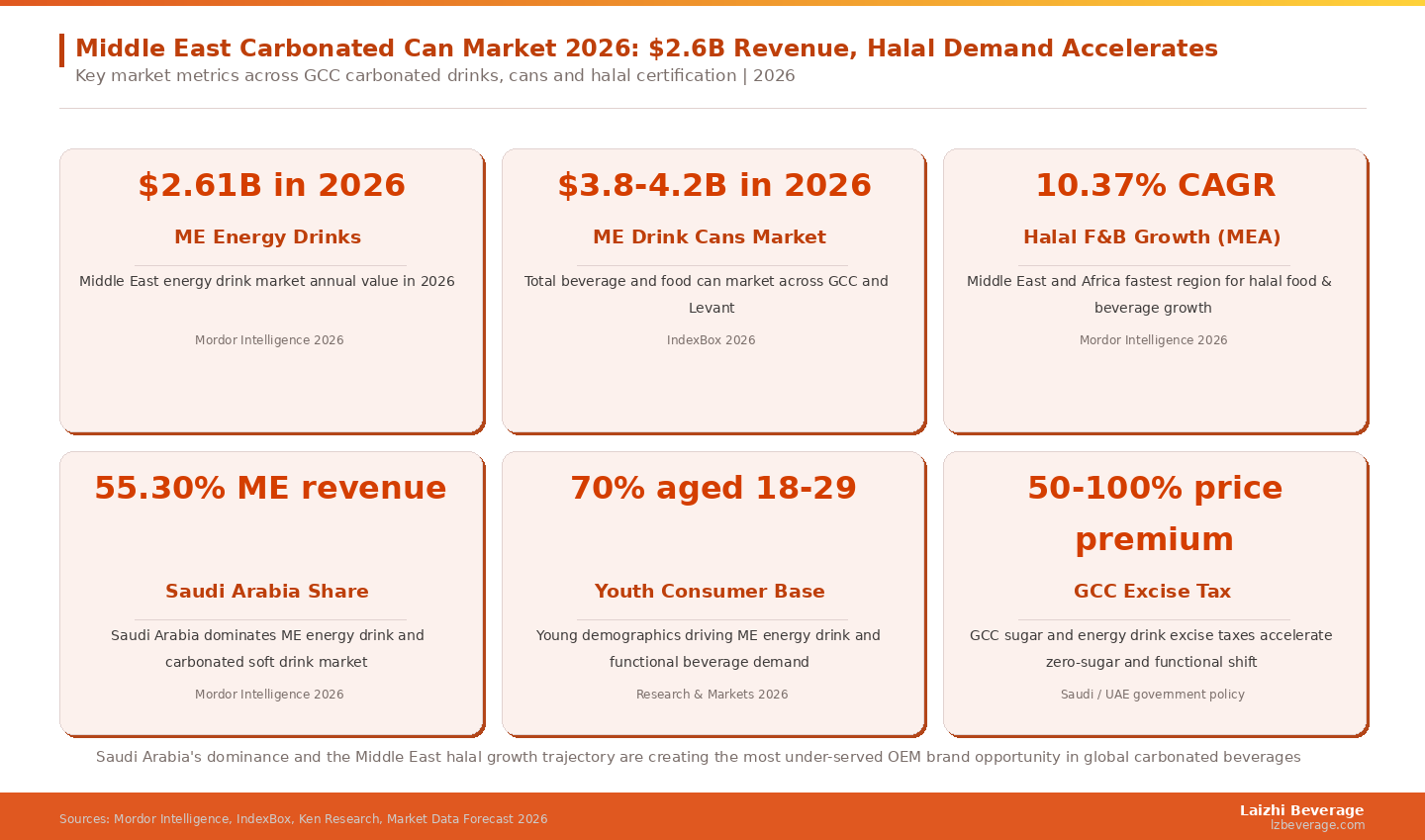
- The Middle East energy drink market stands at $2.61B in 2026, growing at 5.08% CAGR, with Saudi Arabia holding 55.30% of regional revenue.
- The Middle East drink cans market is valued at $3.8–4.2B in 2026, growing at 4.5–5.5% CAGR — with carbonated soft drinks accounting for 45–50% of can volume and energy drinks 15–18%.
- The global halal food and beverage market is $880B in 2026, and the Middle East and Africa region is projected to grow at the fastest regional CAGR of 10.37% through 2031.
- GCC excise taxes (50–100% price surcharge on sugary drinks and energy drinks) are structurally reshaping the carbonated drink market toward zero-sugar, functional, and natural positioning — a regulatory forcing function that OEM brands can design around from the outset.
- 70% of Middle East energy drink consumers are between 18 and 29 years old, and 63% of Saudi consumers are actively seeking healthier beverage options — defining a target demographic that is simultaneously large and health-responsive.
Market Overview: The GCC as the Carbonated Drink Engine
Saudi Arabia: Market Anchor and Regulatory Benchmark
Saudi Arabia's total soft drinks market is valued at $13 billion, supported by per-capita consumption of 120 liters per year in 2024 and an urbanization rate exceeding 84% of the population. Saudi Arabia accounts for 55.30% of Middle East energy drink revenue — making it the single most important country market in the region for any brand in the carbonated drink category. The Kingdom's demographic profile reinforces this: 70% of energy drink consumers are aged 18–29, and the Vision 2030 initiative's emphasis on active lifestyles and sports participation has structurally increased demand for performance-adjacent beverages.
However, entering the Saudi market with a conventional sugary carbonated drink in 2026 is a poor commercial proposition. Any drink with natural or artificial sugar content faces a 50% price surcharge payable to the Saudi government. Energy drinks carry a 100% excise tax. This fiscal environment has made sugar-free and functional formulation positioning not just a consumer preference — it is a price competitiveness requirement. Saudi Arabia's Vision 2030 framework has also led the Ministry of Education to ban soft drinks in schools, and the Saudi Food and Drug Authority introduced caffeine labeling requirements in 2025. Brands entering the Saudi market need formulations that are compliant, competitively priced post-tax, and positioned around functional or wellness credentials.
When the 100% excise tax on energy drinks is placed alongside Saudi Arabia's 55.30% share of the regional energy drink market, a counterintuitive dynamic becomes clear: the tax did not kill the market — it filtered it. The brands and products that thrived post-excise are precisely those with credible functional positioning (zero-sugar, vitamins, electrolytes, adaptogens) where the per-unit value proposition justifies a higher shelf price. This means the Saudi Arabia energy drink market in 2026 is actually more favorable for premium, well-differentiated OEM-built brands than it was before the tax — the tax eliminated the margin on commodity products and left white space for brands that can explain their price point through functional ingredient storytelling.
UAE: The Region's Innovation and Export Hub
The UAE operates similarly to Saudi Arabia on excise taxes — 100% on energy drinks, 50% on sugary beverages — but differs in its function as the regional gateway for international brand entry. The UAE's modern retail infrastructure, export-friendly free zone structure, and diverse expatriate population (over 88% of UAE residents are non-nationals) make it the testing ground for beverage brands entering the broader GCC. Functional drinks — those that address stress, sleep, energy, or immunity — hold the largest share of the UAE drinks market, with over 1.6 million liters in off-trade volume. The ESMA and EQM certification requirements for beverages add regulatory complexity but also serve as a quality filter that benefits brands investing in proper formulation and documentation from the outset.
The Halal Certification Imperative
Why Halal Is Not Optional for Middle East Beverage Market Entry
Halal certification for carbonated beverages in the GCC is not a premium feature — it is the baseline requirement for retail listing in Saudi Arabia, Kuwait, Qatar, and most UAE retail channels. The global halal food and beverage market is valued at $880 billion in 2026, and the Middle East and Africa region is projected to record the fastest growth of any global region at 10.37% CAGR through 2031. For carbonated beverage brands, the halal compliance question extends beyond ingredient sourcing — it includes the certification status of processing aids, flavoring agents, colorants, acidulants, and even the can lining materials used in production.
The complexity of halal compliance in beverages is often underestimated by brands entering the Middle East for the first time. A carbonated energy drink using a halal-certified caffeine source but an uncertified acidulant blend faces rejection at the GCC customs gateway. OEM manufacturers who have established and maintained halal certification under recognized international standards (JAKIM, IFANCA, or GCC-accepted equivalents) substantially reduce the compliance burden for brand clients by maintaining certified ingredient supply chains within their existing production setup.
Natural and Organic Variants: The Halal-Adjacent Opportunity
Natural and organic energy drink variants are growing at a 7.13% CAGR in the Middle East through 2031 — significantly faster than traditional formulations. The convergence of halal compliance, GCC health awareness campaigns, and consumer-led clean-label preference is creating a distinct product positioning opportunity: a halal-certified, natural ingredient, zero-sugar carbonated energy or functional drink that can credibly claim both religious compliance and health-forward positioning. Brands that can occupy this intersection — which requires specific formulation, certified supply chain, and packaging claims — face substantially less competition than those entering with conventional formulations in the same price bracket.
Packaging Format: Why Metal Cans Dominate in the GCC
The Middle East drink cans market is valued at $3.8–4.2 billion in 2026, with carbonated soft drinks accounting for 45–50% of total can volume and energy drinks at 15–18%. Metal cans are the dominant packaging format for carbonated beverages in the GCC for structural reasons: the region's extreme heat and limited cold chain infrastructure make ambient shelf-stable packaging essential, and the aluminum can's superior barrier properties — protecting against temperature fluctuation, UV light, and oxygen — make it the most reliable packaging format for carbonated beverages traveling through the Gulf's distribution channels.
The GCC's can manufacturing capacity is concentrated in Saudi Arabia, the UAE, and Egypt, with 65–75% of primary raw materials (aluminum coil and tinplate) imported — primarily from China and Europe. This creates a natural sourcing relationship: brands manufacturing carbonated canned beverages through OEM partners in China can reach GCC distribution with competitive landed costs, provided the OEM partner has established halal certification and GCC customs documentation capabilities. Understanding the can format specifications required for GCC retail placement — including labeling language requirements (Arabic mandatory alongside English), caffeine warning standards, and halal mark positioning — is essential context before commissioning a production run.
Regulatory Landscape: Navigating GCC Market Entry
Excise Taxes as a Formulation Forcing Function
The GCC's excise tax framework — 100% on energy drinks and 50% on sugary beverages in Saudi Arabia and the UAE — is the single most important regulatory factor shaping carbonated drink product development for the Middle East market in 2026. At 100% excise, a canned energy drink that would retail at $1.50 in a non-excise market retails at approximately $3.00 in the GCC, before retailer margin. This price point only makes commercial sense if the product carries sufficient perceived value to justify the premium — meaning functional ingredients, premium branding, clean-label credentials, or halal-certified natural formulation. Standard-caffeine, high-sugar, generic-positioning energy drinks are structurally uncompetitive in the GCC excise environment.
Saudi FDA Caffeine Labeling (2025) and Other Compliance Requirements
The Saudi Food and Drug Authority's 2025 caffeine labeling requirement — mandating specific caffeine content disclosure and health warnings on packaging — adds a compliance layer that directly affects can label design and production runs. Brands must lock in Arabic-language labeling at the design stage, not as an afterthought post-production, since relabeling import cans adds cost and delay that typically makes the first production run commercially unviable. Working with OEM manufacturers that have experience in GCC export documentation and multi-language label specification is the most practical way to address this constraint without requiring the brand to develop in-house regulatory expertise.
OEM Strategy: What Works for Middle East Market Entry
The optimal OEM entry strategy for the Middle East carbonated drink market in 2026 combines four elements: a zero-sugar or reduced-sugar formulation (to mitigate excise tax impact); a halal-certified ingredient supply chain confirmed at the OEM level; a premium aluminum can format with Arabic-compliant label design; and a two-stage market entry plan that begins with UAE (using its free zone structure for inventory positioning and distribution testing) before expanding to Saudi Arabia once the product has cleared UAE retail validation.
The Middle East's beverage flavoring market — particularly natural and nature-identical flavors — is growing at 7.5–9.0% CAGR through 2035, and the fastest-growing flavor sub-segments are enhanced water, sports drinks, and functional beverages at 10–13% annually. For brands formulating for the GCC, flavors that incorporate indigenous botanical references — rose, saffron, cardamom, dates, tamarind — are significantly underutilized in mainstream carbonated beverage offerings and represent a genuine white space for differentiated product development with strong local resonance.
Next Steps Action Plan
- This week: Verify your formulation is zero-sugar or low-sugar before entering GCC — the 50-100% excise tax on sugary products makes conventional CSD formulations structurally uncompetitive at GCC retail price points.
- This week: Confirm halal certification status of all key ingredients with your OEM manufacturer — including caffeine source, acidulants, flavoring agents, and can lining materials. Gaps in any ingredient category can fail customs clearance.
- Next month: Commission Arabic-language label design with caffeine content disclosure and halal certification mark placement that meets Saudi FDA 2025 requirements and UAE ESMA standards simultaneously — one label template for both markets where possible.
- Next month: Develop a region-specific flavor brief incorporating GCC botanical preferences (rose, cardamom, tamarind, dates) — these are underutilized in carbonated beverages and carry strong local resonance without requiring new ingredient certification.
- Before launch: Begin with UAE free zone distribution as your first-stage market test — UAE's multicultural consumer base and established e-commerce infrastructure provide a lower-risk validation environment before committing to Saudi Arabia's larger retail network.
Frequently Asked Questions
Is halal certification mandatory for all carbonated beverages in the GCC?
For practical retail listing purposes, yes. While the technical legal requirement varies by country (mandatory in Saudi Arabia and Kuwait; highly expected in UAE and Qatar), no major modern retail chain in the GCC will list a carbonated beverage without halal certification from a recognized international or regional certifying body. Brands treating halal as optional are effectively excluding themselves from the GCC's mainstream retail channels.
How do GCC excise taxes affect the commercial viability of carbonated drink brands?
Significantly — but in a targeted way. The 100% excise on energy drinks and 50% on sugary beverages means conventional high-sugar formulations must retail at 1.5–2x their base price to recoup the tax, compressing margin and limiting consumer affordability. Zero-sugar, diet, or functional variants (which may face lower or no excise depending on formulation) are structurally more commercially viable in the GCC excise environment. Brands entering the Middle East with a sugar-free or functional positioning from the product brief stage avoid this margin compression entirely.
What is the minimum OEM production setup for GCC market entry?
A practical minimum: a halal-certified sample run (500–2,000 cans) for retail buyer samples and customs registration; a pilot production lot (10,000–30,000 cans) for UAE pilot distribution; and a first commercial production run sized to cover 3–6 months of initial retail placement across 50–150 SKU locations. OEM partners with GCC export experience can advise on HS code classification, certificate of origin requirements, and halal documentation formats required by Saudi Customs and UAE Port Authorities — all of which need to be resolved before the first commercial production run, not after.
Which GCC country is the best first market for a new carbonated drink brand?
The UAE is the recommended first market for international brands entering the GCC. The UAE's free zone structure allows inventory to be held in Dubai without full customs clearance, enabling market testing; its diverse expatriate consumer base provides a relatively broad test demographic; and its established e-commerce and modern retail infrastructure (Carrefour, Lulu, Noon, Talabat) provide accessible distribution channels for new brand SKUs. Saudi Arabia is the volume prize — but its regulatory complexity, excise structure, and deeper localization requirements make it a better second market after the UAE validates product-market fit. Exploring how experienced beverage OEM manufacturers approach GCC export documentation and halal compliance is a valuable early orientation step before committing to product specifications.


